

What the Farm Grows Besides Flowers
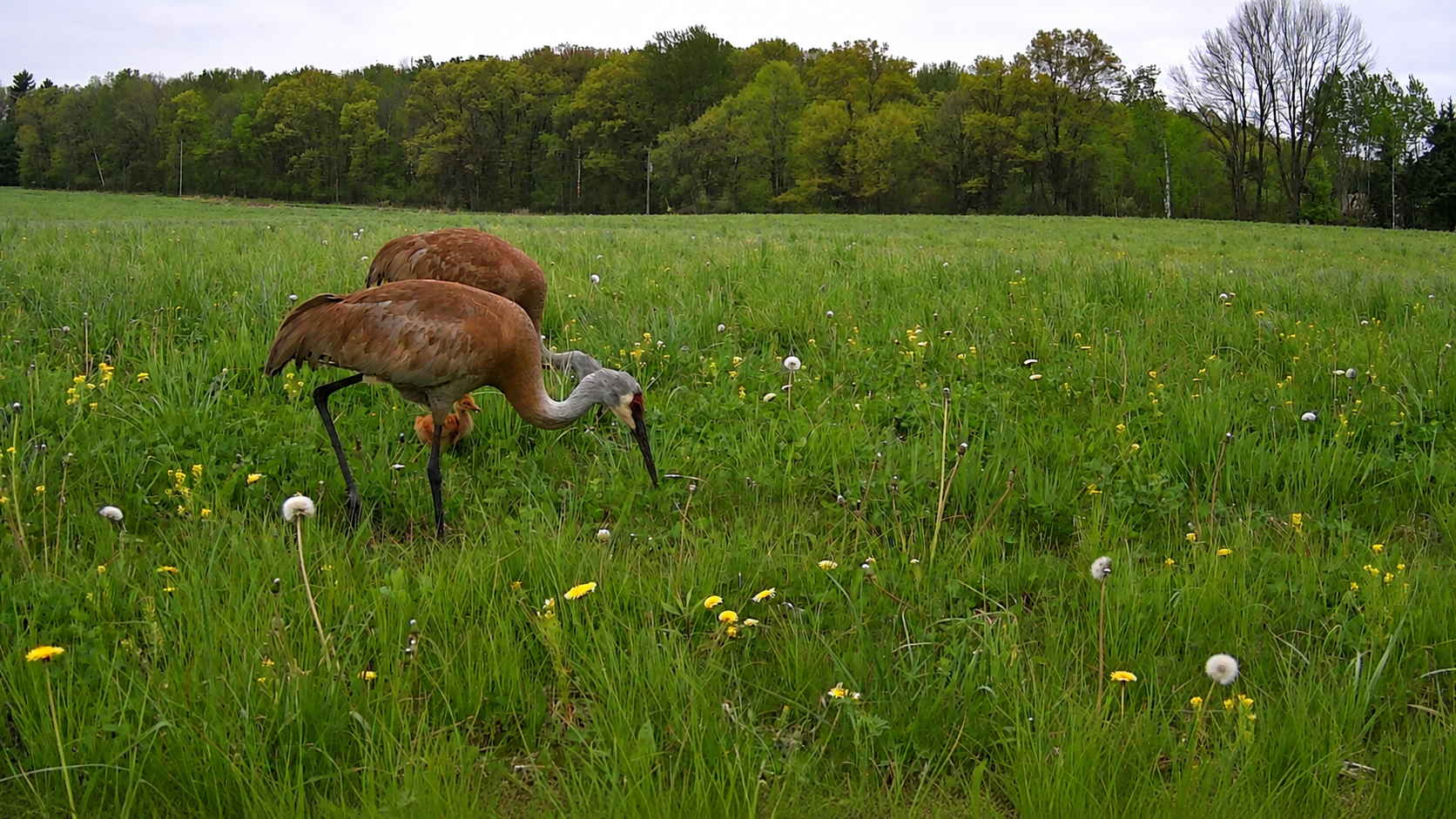
Colt our for a stroll with mom and dad
Value Added, But Not for Sale
A flower farm has obvious crops: stems, bouquets, buckets, seeds, roots.
But there is another kind of yield here too — the kind that does not go in a vase, does not fit on a price sheet, and is not for sale.
This spring and early summer, that other yield has looked like crane colts in the field, fawns in the white clover, caterpillars tucked into leaves, raccoon kits with questionable manners, fledgling birds around the house, and young ravens adding their awkward clamor to the tree line.
It started, at least in my mind, with a doe who seemed to decide our yard was a perfectly acceptable fawn daycare.
The first time she left her fawn near the house, she actually poked her head right up to the bedroom window. Sierra was still in bed, and I think the doe scared her about as much as Sierra startled the doe. For a second, it felt like the deer was saying, “Your turn. I’ll be back later.”
And honestly, what are you supposed to do when a deer assigns your household daycare duty?
For a while, we saw fawns almost every day. Quiet little shapes in the grass. Long legs figuring themselves out. A mother moving through the yard like she knew exactly what she was doing.
And she probably did.
A few days later, we saw at least three fawns tucked into the garden with a group of mothers, right in the middle of what is, at the moment, apparently our most productive crop: white clover.
It is hard to complain too much. A flower farm is supposed to grow beauty, and sometimes beauty looks like spotted fawns folded into the green, pretending very seriously that nobody can see them.
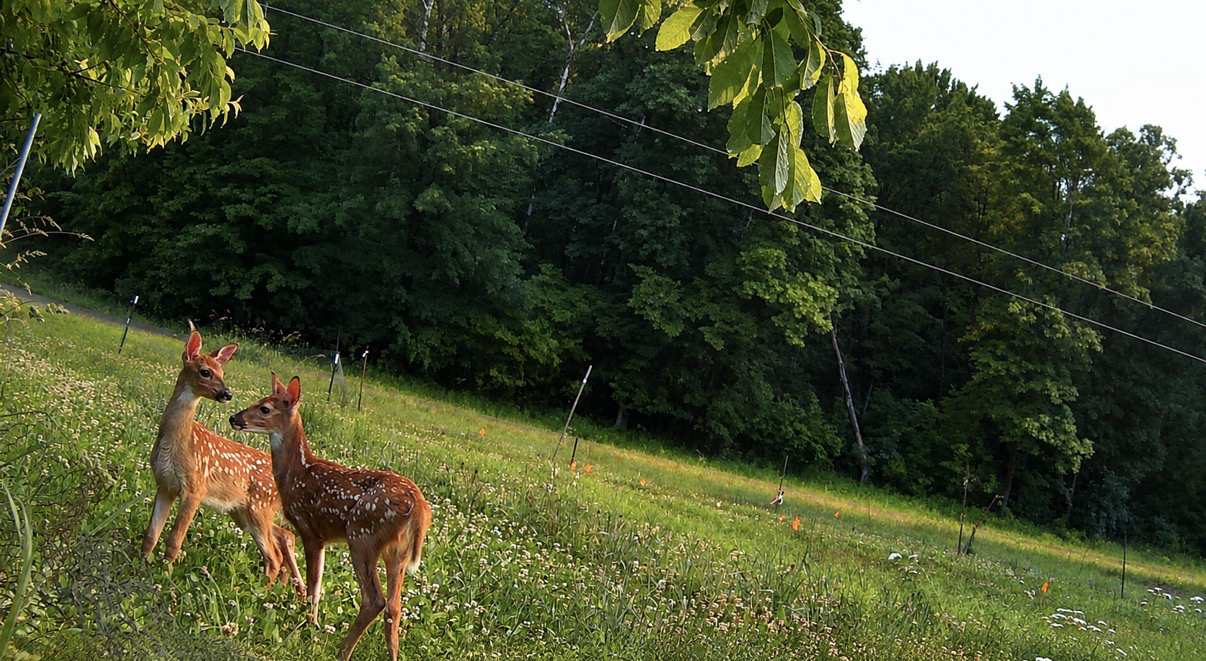
Twin fawns enjoying a buffet of white clover
The sandhill cranes have been raising their own young in the field, too. There is something wonderfully ancient-looking about crane colts following their parents through the grass — small, fuzzy, and somehow already carrying themselves like they belong to a much older world.
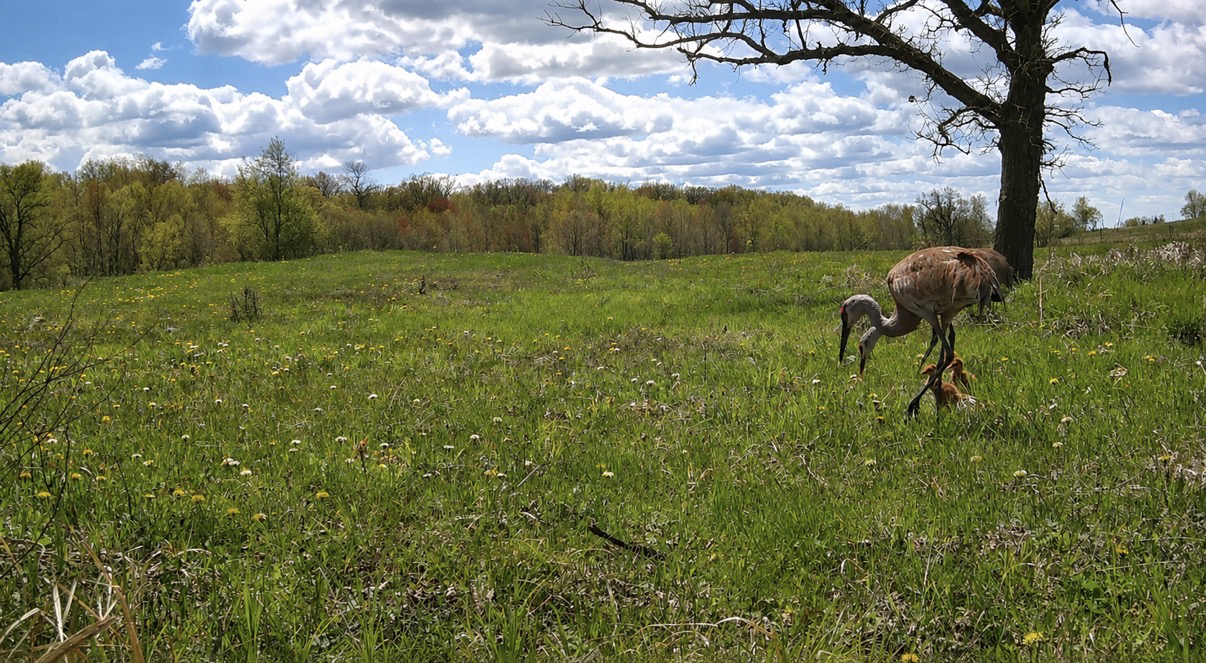
Colts out to explore.
The baby bunnies have been loitering with our flock of ducks, making the yard look briefly, absurdly, like an Easter card.
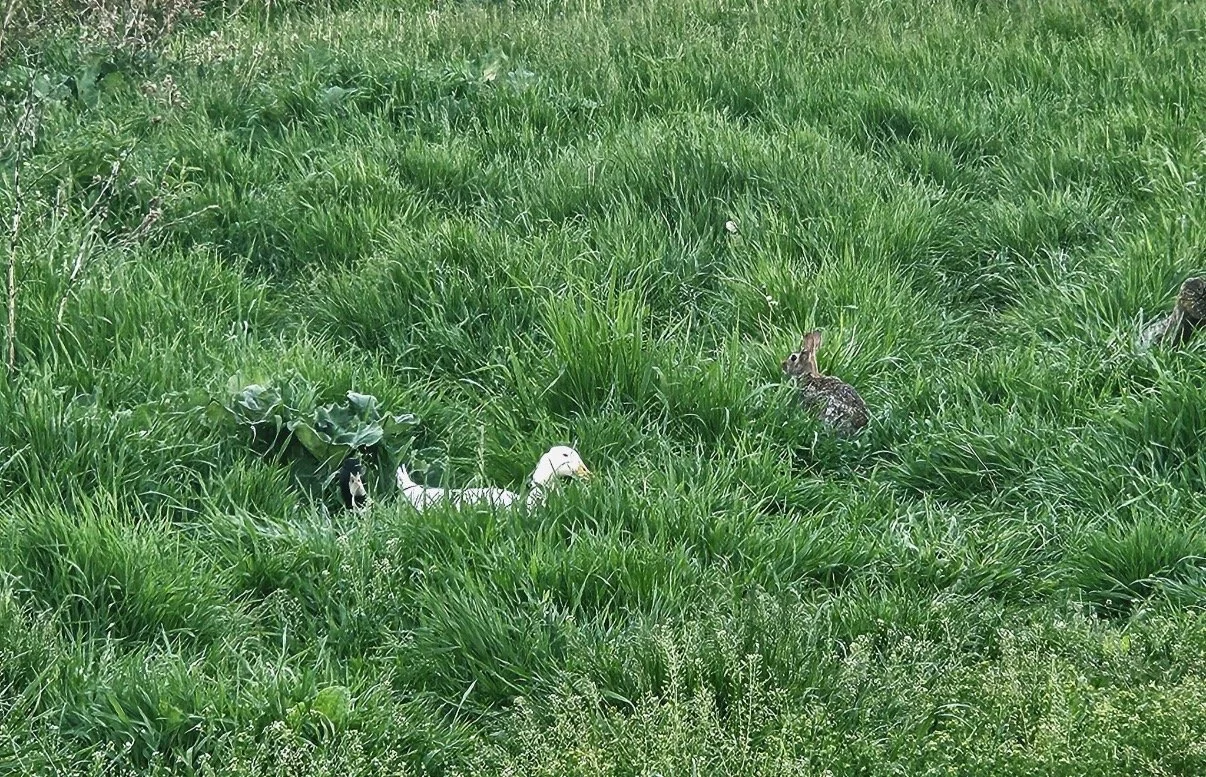
Pair of ducks sun bathing with a baby bunny
Baby chipmunks have been running all around the house. Fledgling robins and sparrows are out in the yard. Those are just the ones we see. From all the nesting sites around the farm, we hope there are baby bluebirds, orioles, and maybe even hummingbirds tucked into the summer somewhere too.
And then there is the newest member of the Air Force: a baby pigeon, barely hatched, already part of the farm’s ongoing bird department.
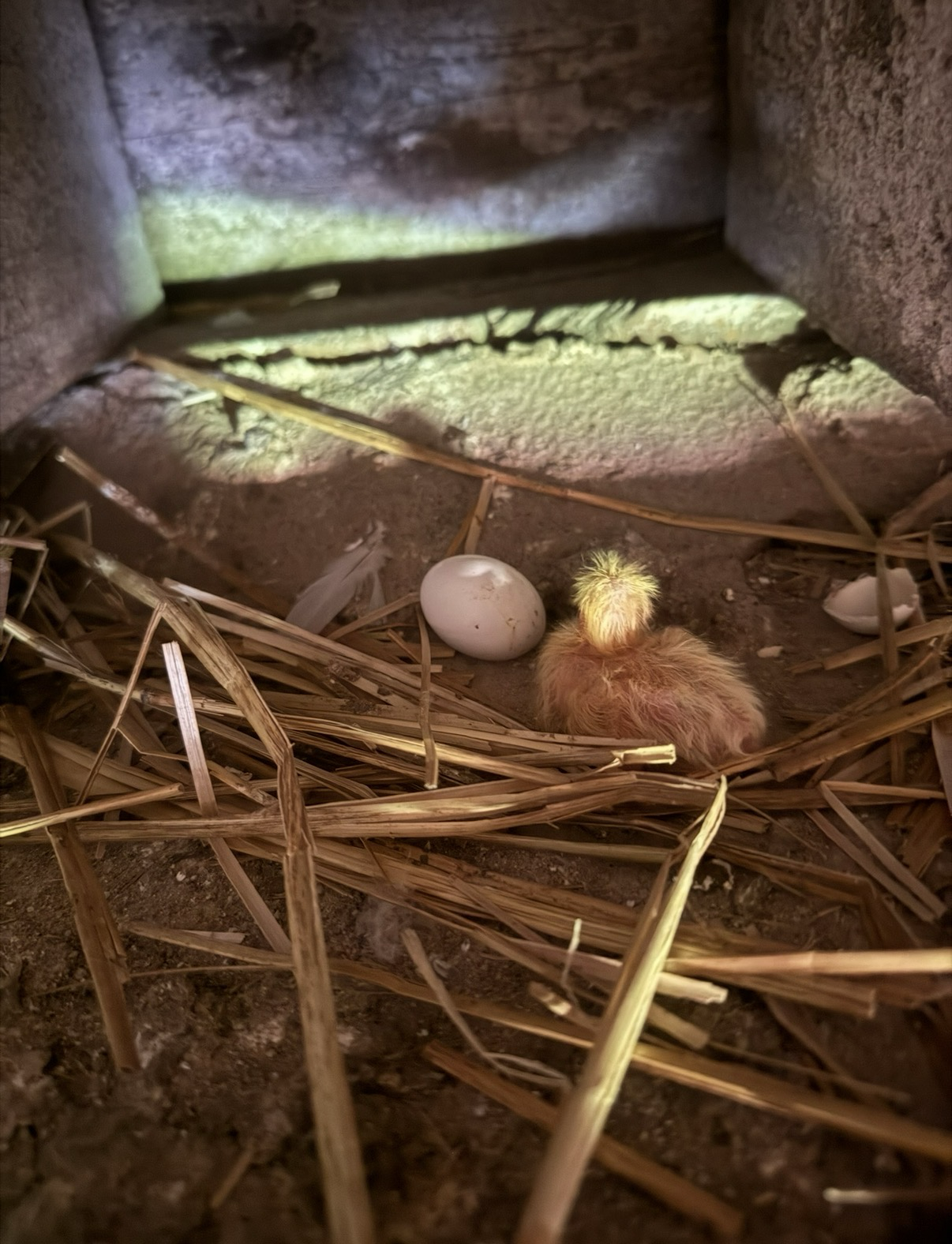
New member of the pigeon air force
Most years, we also get a mother raccoon who brings her babies to party in our pole shed before dark. They are adorable and destructive, and we love them in the complicated way you love something that may also rearrange your belongings. They have not started that tradition yet this year. Given that the chickens live nearby in the barn, that is probably not the worst news.
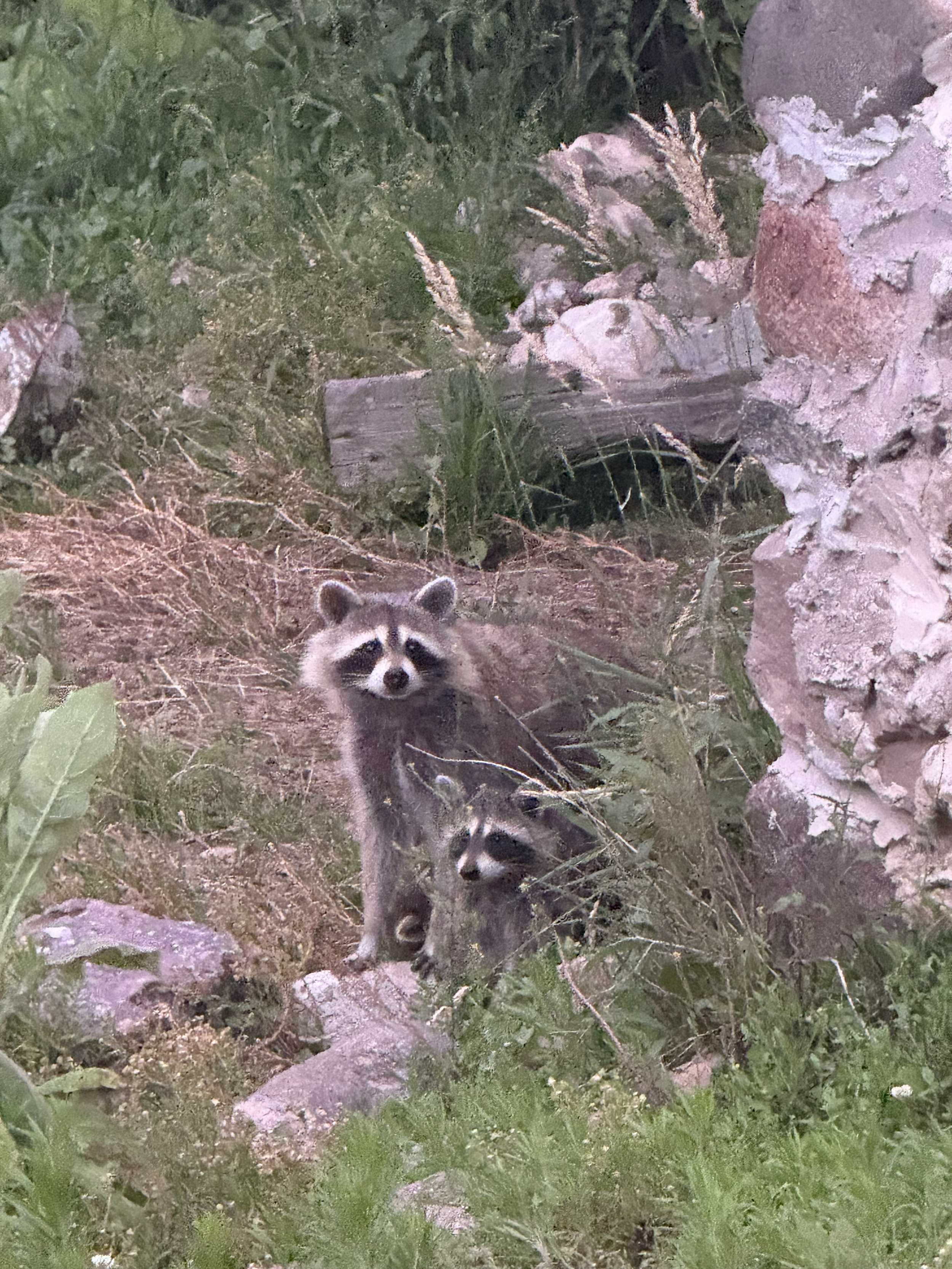
Mom keeping her kits close
That is one of the strange, beautiful parts of living on a farm like this. We are not the only ones using the land. The field edges, tall grass, wetlands, brushy corners, flowers, weeds, and messy places all become part of somebody’s nursery.
Some of the young life is easy to notice. Fawns in the yard. Colts in the field. Raccoon kits looking like they have already made a plan and it is not a good one.
Others ask you to look a little closer.
This spring we have also been finding caterpillars and larvae tucked into leaves, doing the quiet work of becoming something else. They are not always the most obvious part of a flower farm, but they are just as important. A healthy farm should have chewed leaves. It should have insects. It should have small things eating, growing, hiding, changing, and feeding something else.
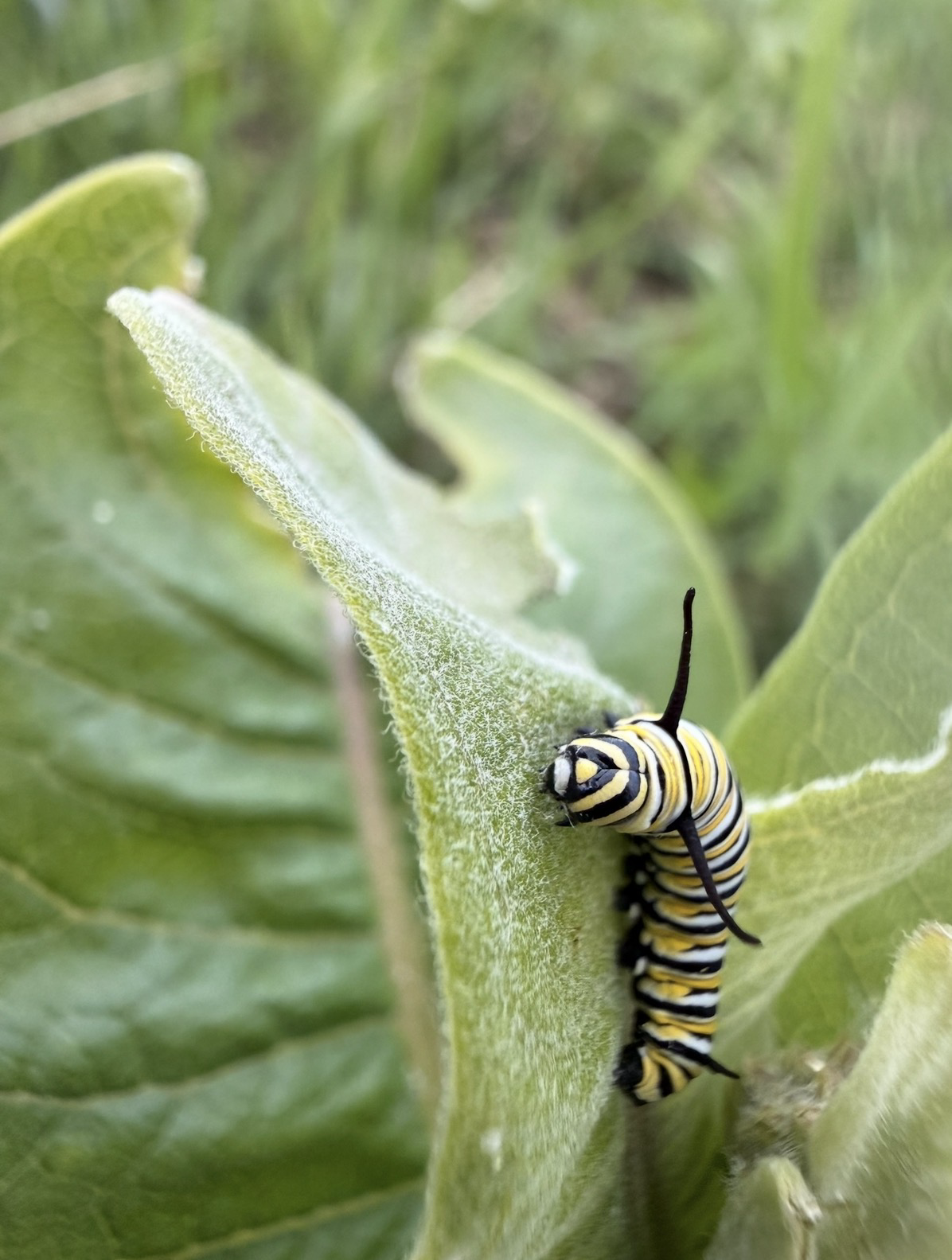
monarch caterpillar on milkweed
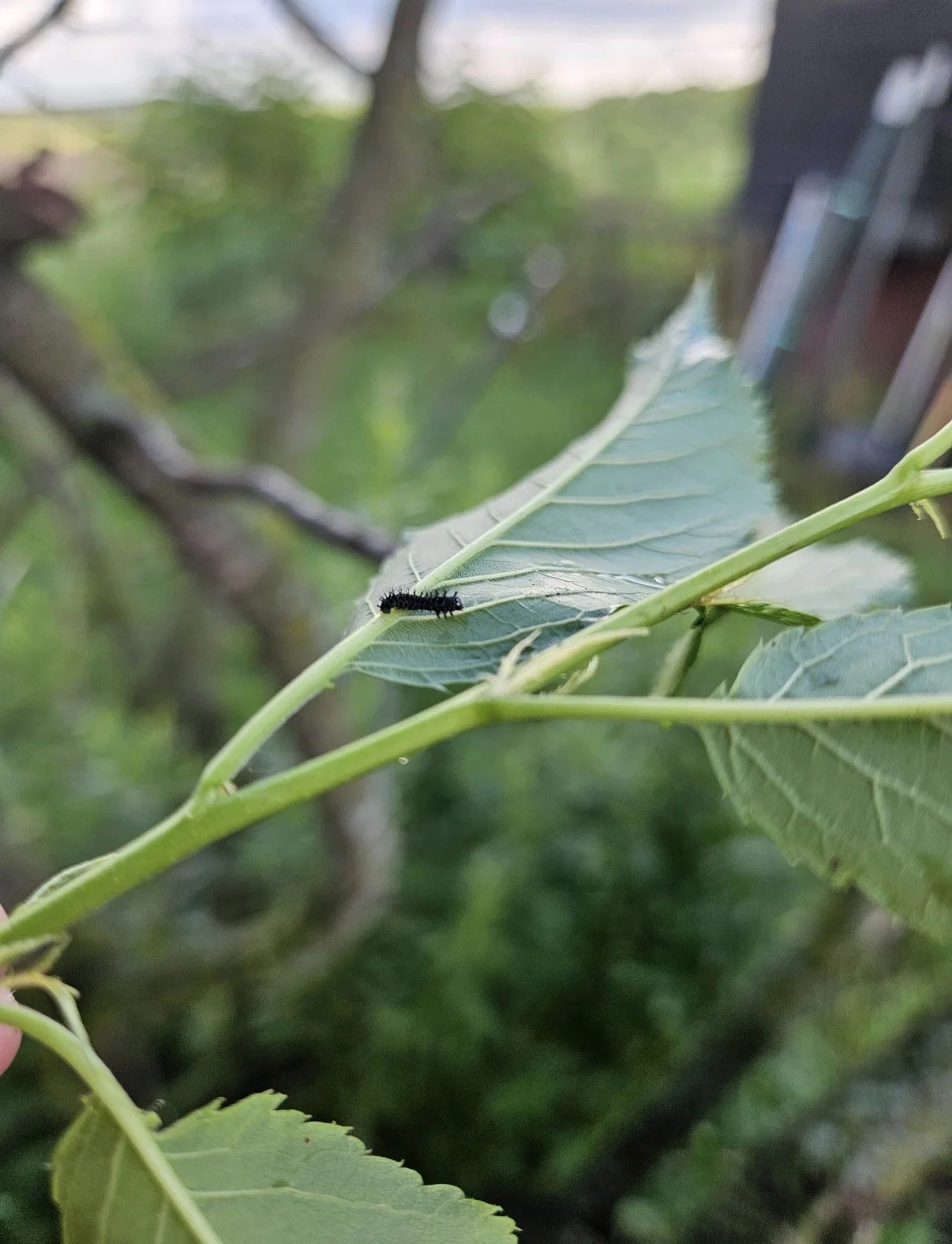
Newly hatched cecropia caterpillar
One day we found a spectacular moth in the shade house. At first, it seemed like one very impressive visitor. Then I went and got Sarah, and she noticed there were actually two of them — and they were mating.
I believe they were cecropia moths, one of those creatures that feels almost too elaborate to be real. They do not get much time as adult moths. By the time they have those huge patterned wings, their work is mostly to find each other, mate, and lay eggs.
The next day, we found the eggs. We moved them out to the wild plum grove, then let the moths out of the shade house so they could spend their short time as beautiful moths around the yard.
There is something very humbling about that: a whole year of becoming, and then only a brief window to fly.
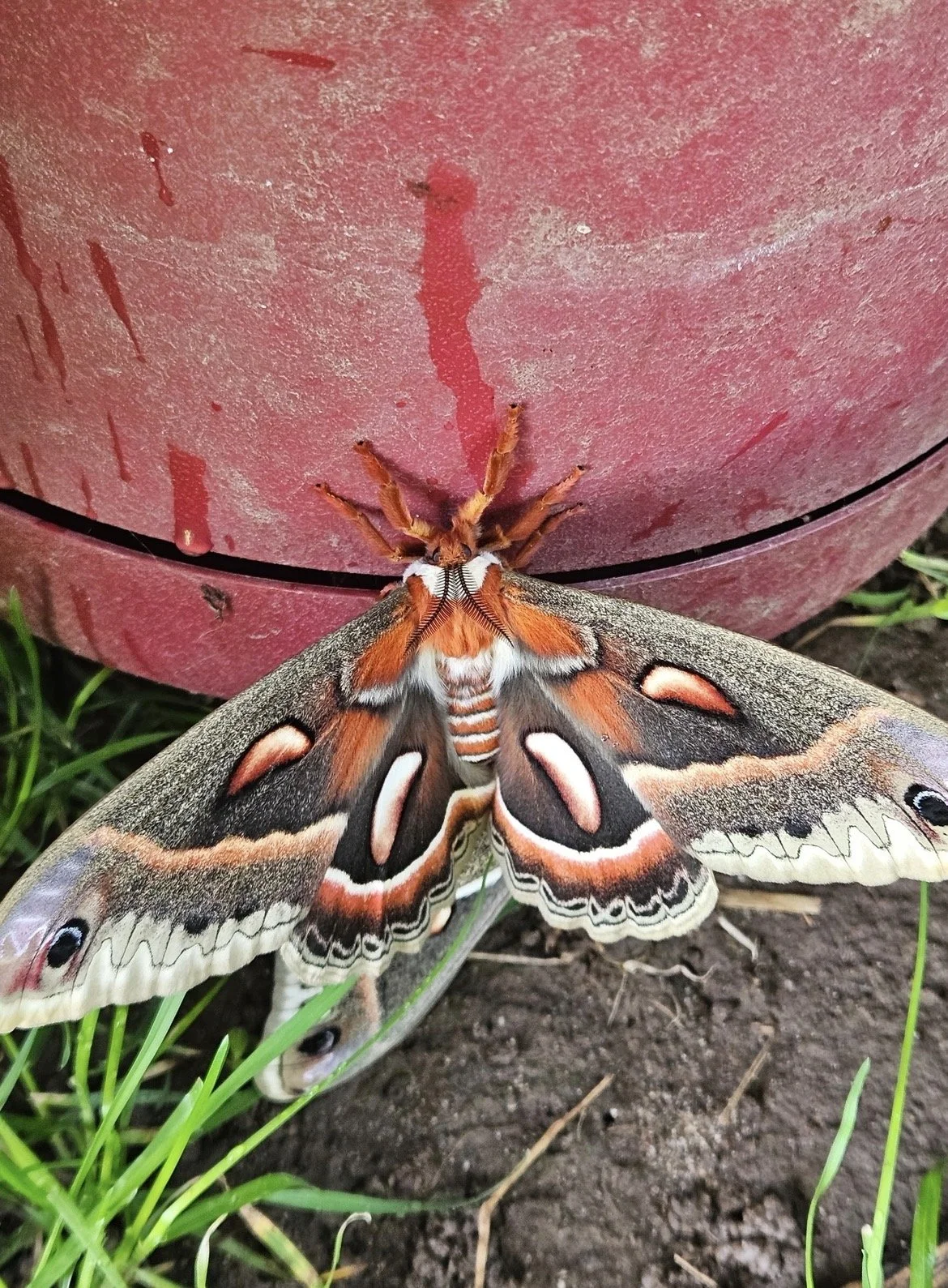
cecropia moth
The raven fledglings are out now, too, and apparently that has shifted the local politics. With a whole horde of young ravens making noise in the trees, the ravens seem to have pushed their territory line back again in the ongoing dispute with the crows.
The last few days have been full of strange calls, begging sounds, arguments, warnings, and whatever else passes for neighborhood meetings in the corvid world. It is not exactly peaceful, but it does make the farm feel intensely alive.
We have had a few other signs of young life around the edges, too — baby woodcock nearby, and reports of baby owls in the neighborhood. I will not claim every nest and fledgling as ours, but it does feel like the whole hill has entered nursery season.
That is what I keep coming back to this year. Firefly Hill is a flower farm, but the flowers are only one piece of the story.
We grow bouquets here, but we are also trying to grow habitat. We want this place to be beautiful in a way that lasts beyond a vase. Beautiful for pollinators. Beautiful for birds. Beautiful for deer moving through at dawn, cranes calling from the field, caterpillars hiding under leaves, and fireflies rising from the grass at night.
Not every part of nature is soft or simple. Sometimes the value-added crop chews the leaves. Sometimes it makes a racket in the tree line. Sometimes it tries to move into the pole shed. Sometimes it stands in the garden and eats the white clover like it has every right to be there.
And maybe it does.
The farm grows flowers, but it also grows shelter, food, cover, noise, mess, motion, and new life.
None of that fits very neatly on a price sheet.
But it is still part of the yield.
The Wild and Wonderful Birds of Firefly Hill Farm (By Season)
Meet the wild birds of Firefly Hill Farm (by season), plus a few notes on the landscape features that make these sightings possible.
If you spend any time at Firefly Hill Farm, you’ll notice something pretty quickly: it’s rarely quiet. Yes, our domestic birds have opinions, but the wild birds are just as audible. House sparrows chatter as they bounce from crab apple to crab apple. Blue jays have an array of calls—from metallic “donks” to perfect impressions that can sound like a hawk. Woodpeckers drill into trees for a snack. Ravens clonk as they do acrobatics in the sky. In spring, cranes call across the marsh and the sound carries into the distance. Even the wings overhead have their own sound—pigeons (our little “Firefly Air Force”) circling the farm and patrolling the sky. There are a lot of birds here, so this is a long post. If you don’t want to take it all in right now, feel free to skim—winter is where we’ll start, because winter is where people assume everything goes quiet, and that couldn’t be further from the truth.
Winter: Feeders, finches, and surprise visitors
Most days in winter the homestead feels surrounded by life. We’ll often have three to five pairs of cardinals, a steady bounce of blue jays moving between treetops and feeders, and juncos and house sparrows hopping under the feeder line and slipping back into the hedges. Pine siskins, white-breasted nuthatches, and tufted titmice work the trees like they’re built for it—up, down, sideways, sometimes upside down. Woodpeckers move between suet and the standing dead trees we leave on safe parts of the property. (We keep a few snags because they’re habitat—simple as that.) One of our favorite winter routines is feeding the birds. We don’t feed all season long—most of the year the farm offers plenty through berries, insects, and seeds, and we also don’t need extra reasons to draw in herbivores like deer and rabbits. But in winter, feeders turn the yard into a little viewing stand. This year we strung a clothesline across three trees and hung platform feeders for “everybody,” tube feeders for finches, and a few ground feeders for juncos. Squirrels get into it no matter what; we live with it—and they’re part of the show. Deer clean up what hits the ground, and wild turkeys come by now and then to see what everyone left behind.
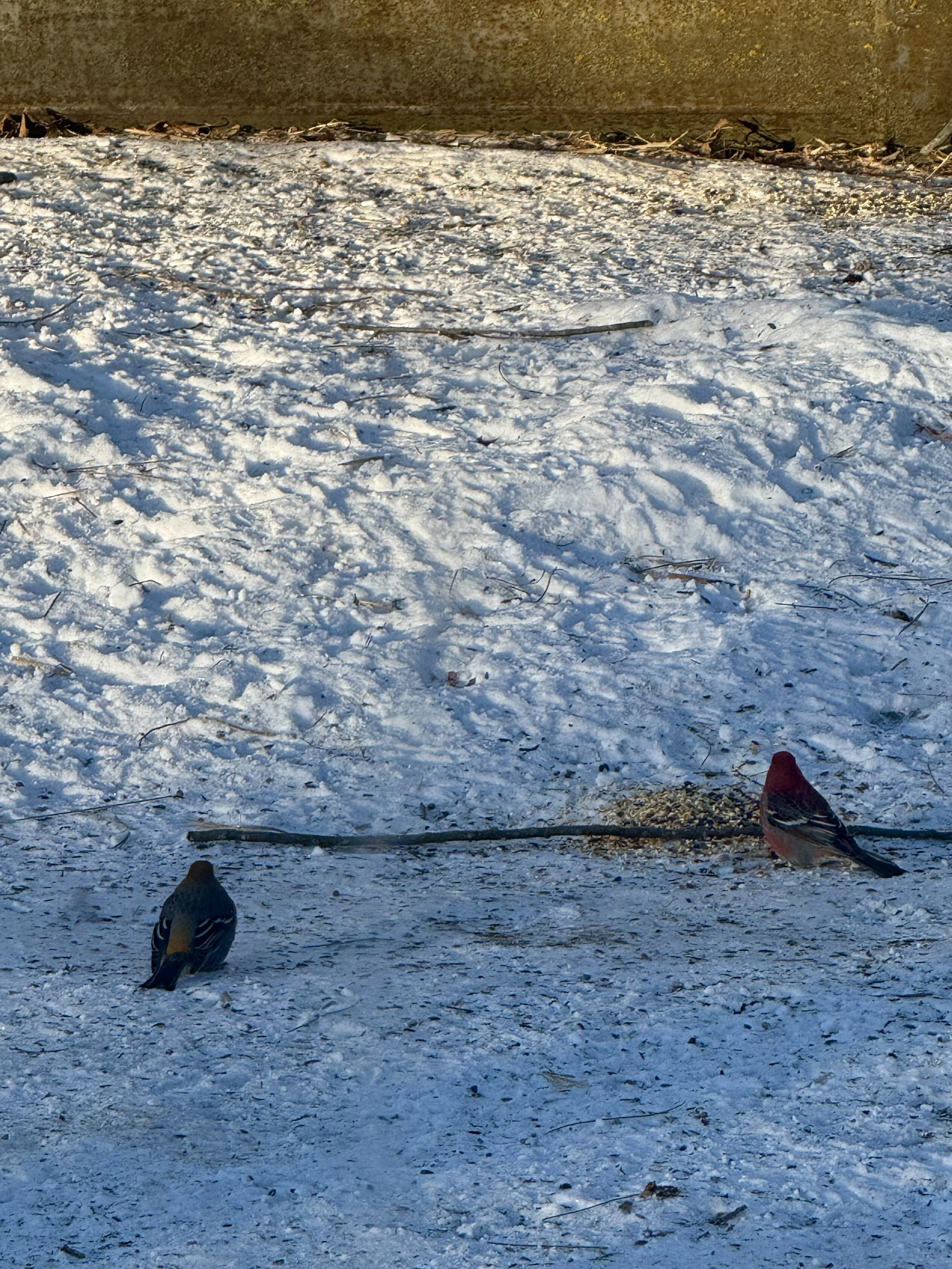
Rare sighting: Pine Grosbeaks at the feeder — male (red) and female (gray/brown).
This winter we had a rare visitor—one that’s new on our life list: pine grosbeaks. A male and a female showed up during this stretch of weather that felt like Canada, and they stuck around long enough to feel like part of the place for a while. They stood out immediately, and we watched them working the winter leftovers—likely sunflower seed scraps on the ground. Winter also makes predators more visible. We often see a red-tailed hawk posted up in a giant oak in the pasture, scanning the harvested field. We also get sharp-shinned hawks around the farmstead—smaller, bolder, and sometimes willing to stalk the feeders. We’re careful with our livestock, especially the babies, but we also respect the role these birds play in keeping rodents in check. We get flybys of bald eagles traveling to and from the Chippewa River too. And at night, owls are part of the soundtrack as well—barred owls and great horned owls—the kind of presence you often hear before you ever see.
One quiet reason winter stays busy here is that we try not to strip everything down in fall. People clean up their gardens and plots for good reasons—time management, disease control, aesthetics—but we keep as much standing as possible through winter on purpose. We aren’t “never-cleanup” people; we just clean up differently and later. The main perennial we cut back in fall is iris, to reduce the possibility of overwintering iris borer. Most other perennials stay standing until spring when beneficial insects begin waking up, and our cut fields are left standing until the ground thaws. Leaving stems and seed heads matters because it keeps food in the landscape. Even in deep winter we’ll watch finches and sparrows pick seed from plants many people would have cut down: bee balm, rudbeckia, scabiosa, and more. Ageratum and amaranth can drop thousands of seeds too, and that food adds up when every calorie counts. We also cycle nutrients back onto the fields in winter by spreading barn waste from our bird bedding onto the cut fields—nothing glamorous, just real farm cycling that adds organic matter and keeps the ground protected through the hardest stretch of the year.
Spring: Scouts, marsh music, and the first big return
We like to think spring starts in late February. Some years we’ll get robin “scouts” first—stopping by the farm and then lingering near an elm out in one of the fields for a few weeks. Last year we saw our first robins and red-winged blackbirds on the same day: March 12. The fields pull in killdeer too. If you’ve ever walked near a killdeer nest, you know the performance—acting injured to lure you away. It’s dramatic and it works. Canada geese move in, and sometimes we’re lucky enough to see tundra or trumpeter swans and blue-winged teal moving through. Spring migration brings visitors too—fox sparrows, white-throated sparrows, black-and-white warblers, and lesser and greater yellowlegs.
And then comes the farm favorite: sandhill cranes. We have a plaque in one of our grow rooms from 1981 that says this farm is an owner of a crane marsh. Today cranes are more common than they used to be, but they still don’t feel ordinary. They come early and check what changed over winter. They do a beautiful courting dance. And there is nothing like their trumpeting call—every time we hear it our hearts fill up. One of our favorite days of the year is the annual crane count. We pack coffee and Dunkin donut holes (munchkins), leave the house around 5:30, and head to the far end of the property. We sit by an old deadfall and listen to cranes coming in. We usually count 20 to 30. One year we even heard a bobcat mating call while we sat there—if you’ve never heard it, it’s worth looking up, and it might be one of the most dreadful cries you’ll ever hear. This year we even had a woodcock try to nest between our prairie and driveway. We didn’t get to see baby woodcock, but we took the attempt as a compliment. After reading Doug Tallamy’s Bringing Nature Home, we stopped mowing under our oak trees to leave more habitat for the insects that feed birds. Now it’s a patchwork of asters, grasses, Joe-Pye weed, raspberries, and whatever else wants to join—and spring feels louder because of it.
Summer: Sunflowers, swallows, and hummingbirds
By June, it might as well be summer here. Plants are racing, and the bird calendar shifts again. Bluebirds are established, preceded by orioles, and then the ultimate summer bird arrives: the ruby-throated hummingbird. This year we had a beautiful pair of red-headed woodpeckers nesting in the yard—the kind of bird that makes you stop what you’re doing just to get a better look or listen. We also love the swallows—barn swallows and tree swallows—along with bobolinks, brown thrashers, and the tiny little chipping sparrow. We leave a lot of sunflowers standing and we also grow varieties that are better for birds in addition to varieties we grow for cut production. It’s always a blessing to sit up by the flower field and watch American goldfinches fly from sunflower to sunflower and gorge themselves like they found the best buffet in the county. And in the background of all of it, cranes walk the hay and cornfields—and if we’re lucky, we’ll see colts moving with their parents like tiny dinosaurs.
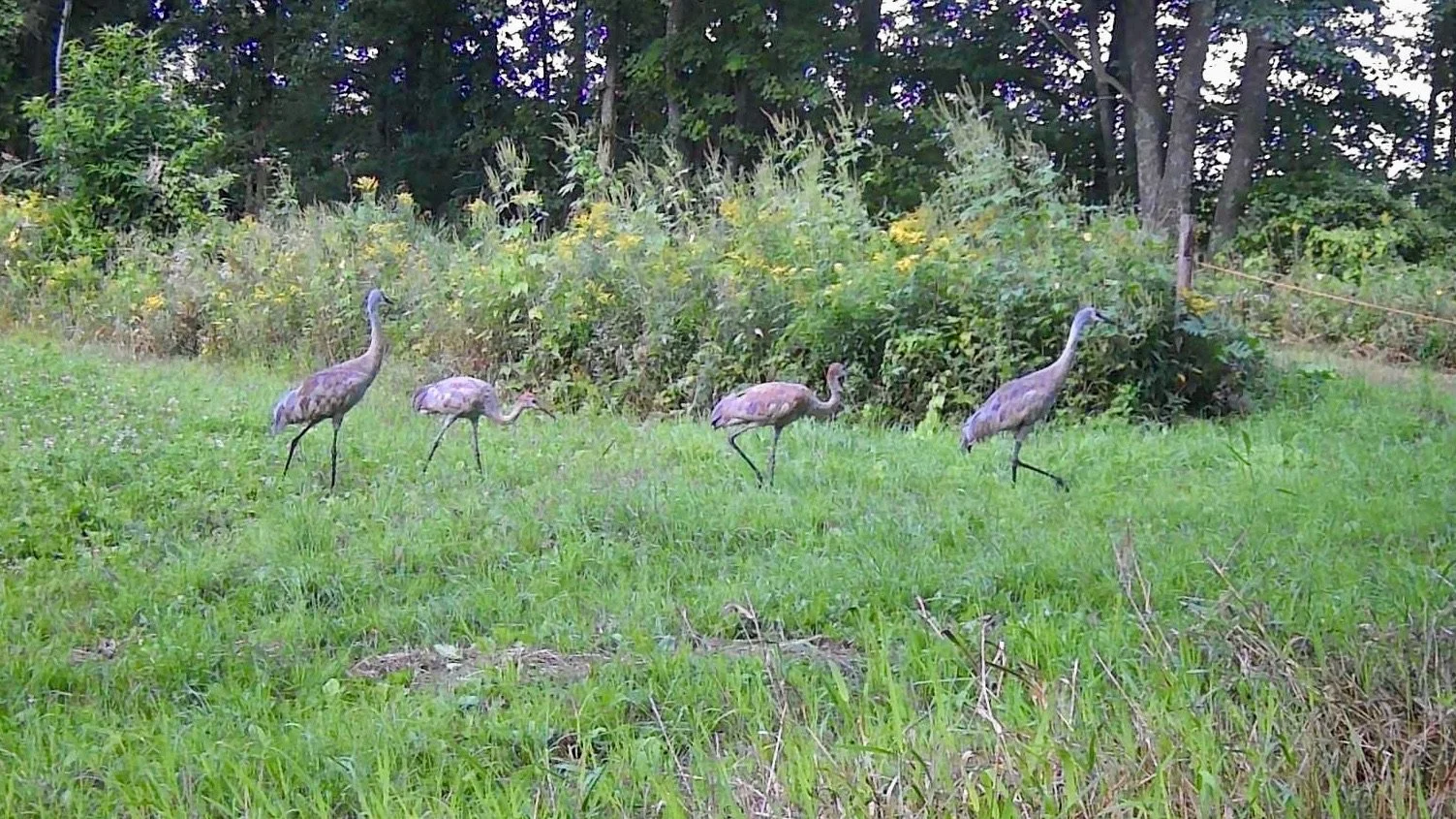
Sandhill crane family in the hayfield — two adults with their colts.
Fall: Swarms, waxwings, and goodbyes
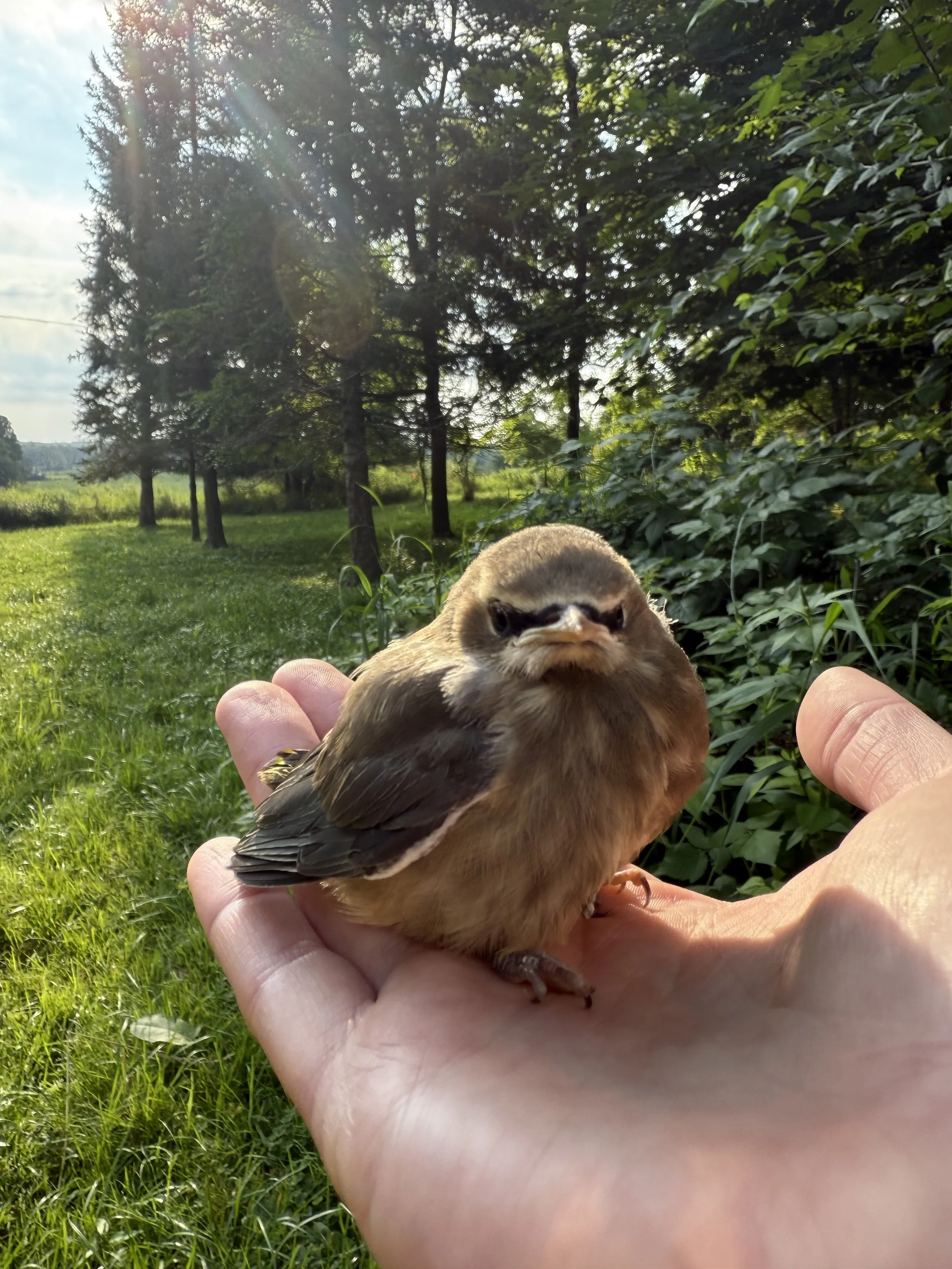
One of the first signs the season is turning is the swarming of nighthawks. We’d never seen anything like it until we came to the farm. They look like a cross between a seabird and a hawk. As evening approaches, they soar through—sometimes hundreds of them—eating insects when insects are at their peak. Another fall favorite is the cedar waxwing. When honeysuckle berries ripen and ferment, those birds seem like they’re having a party. Last season we found a fledgling and it was one of the cutest little angry muppet-things we’ve ever seen.
Fall is also when the crane story turns bittersweet. You can watch the parents take the young ones up and practice flying for weeks. Then one day they lift off, circle higher and higher until they’re just a dot in the sky, and you know they’re on their way out for the season.
Winter again: the familiar birds return
As some birds move on, others return. The arrival of the dark-eyed junco is genuinely one of the best parts of winter. The feeder rhythm starts up again. The yard gets loud again. And the “quiet season” proves—again—that it isn’t really quiet. And maybe, if we keep taking care of the land—leaving cover, leaving food, leaving the edges wild enough to function—we’ll get lucky and see those pine grosbeaks again. That’s the hope. Because at Firefly Hill Farm, the birds aren’t an extra. They’re a sign that the place is alive.
Favorite Birds of Firefly Hill Farm (common name — scientific name)
House Sparrow — Passer domesticus
Dark-eyed Junco — Junco hyemalis
Northern Cardinal — Cardinalis cardinalis
Blue Jay — Cyanocitta cristata
Pine Siskin — Spinus pinus
White-breasted Nuthatch — Sitta carolinensis
Tufted Titmouse — Baeolophus bicolor
American Goldfinch — Spinus tristis
Red-headed Woodpecker — Melanerpes erythrocephalus
Ravens (Common Raven) — Corvus corax
Rock Pigeon — Columba livia
Barn Swallow — Hirundo rustica
Tree Swallow — Tachycineta bicolor
Bobolink — Dolichonyx oryzivorus
Brown Thrasher — Toxostoma rufum
Chipping Sparrow — Spizella passerina
Ruby-throated Hummingbird — Archilochus colubris
Red-tailed Hawk — Buteo jamaicensis
Sharp-shinned Hawk — Accipiter striatus
Bald Eagle — Haliaeetus leucocephalus
Turkey Vulture — Cathartes aura
Barred Owl — Strix varia
Great Horned Owl — Bubo virginianus
Canada Goose — Branta canadensis
Blue-winged Teal — Spatula discors
Tundra Swan — Cygnus columbianus
Trumpeter Swan — Cygnus buccinator
Killdeer — Charadrius vociferus
Lesser Yellowlegs — Tringa flavipes
Greater Yellowlegs — Tringa melanoleuca
Black-and-white Warbler — Mniotilta varia
Fox Sparrow — Passerella iliaca
White-throated Sparrow — Zonotrichia albicollis
American Robin — Turdus migratorius
Red-winged Blackbird — Agelaius phoeniceus
Sandhill Crane — Antigone canadensis
American Woodcock — Scolopax minor
Common Nighthawk — Chordeiles minor
Cedar Waxwing — Bombycilla cedrorum
Pine Grosbeak — Pinicola enucleator
Baltimore Oriole — Icterus galbula
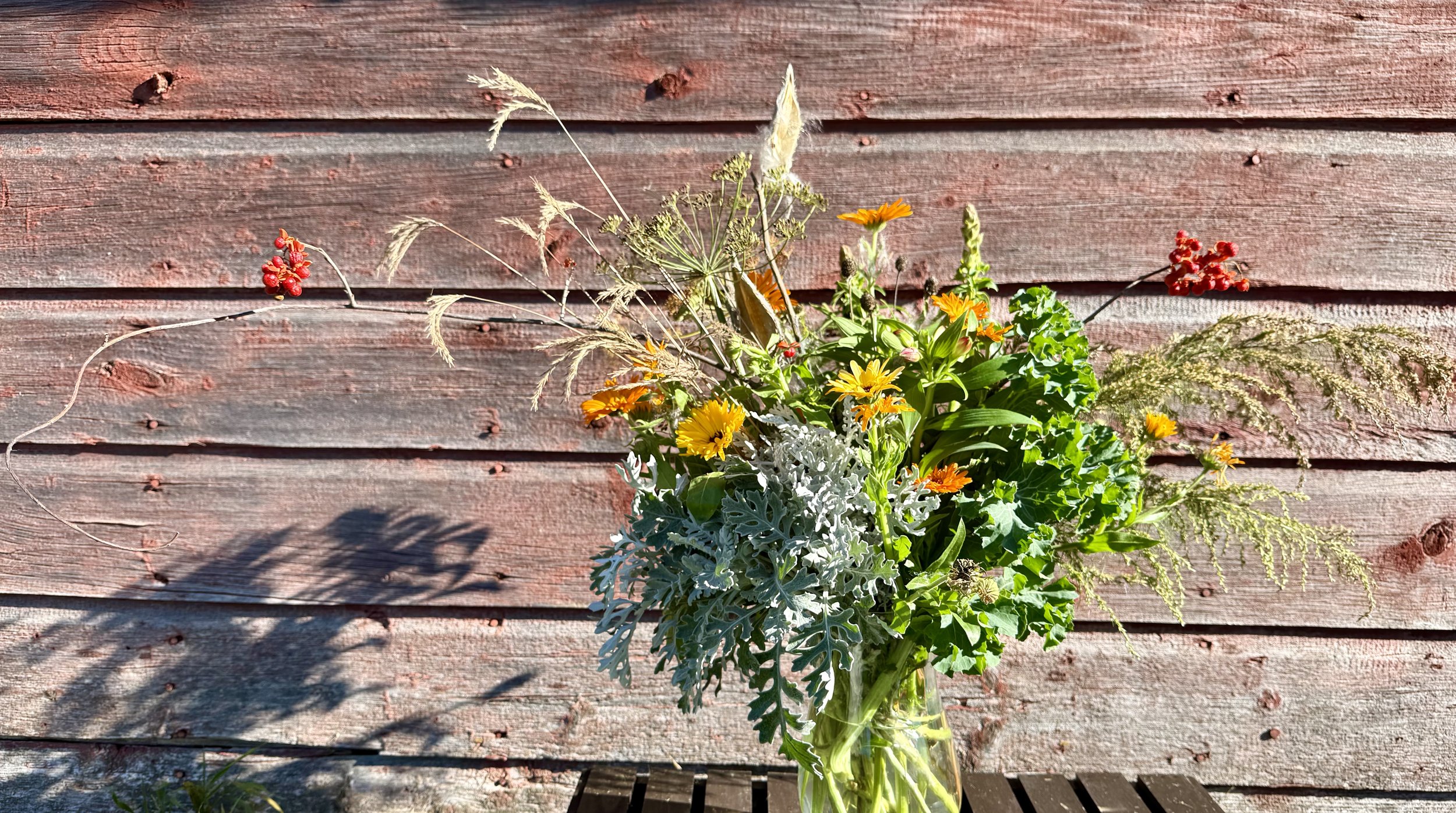
Late-Season Bouquets at Firefly Hill Farm
As October rolls in and most growers start to wind down for the season, Firefly Hill Farm is still hitting its stride. The cool air, softer light, and deeper tones of fall bring out a new rhythm in the field. Many of my favorite stems are just reaching their peak, letting me create distinctive bouquets that bridge the line between autumn richness and winter textures.
This year, even into early November, there’s still enough life left to keep the clippers busy — a reminder that beauty doesn’t stop when frost arrives. If you take a step back from the busy day and look around, you’ll find beauty in so many unusual places. My job is to bottle that up and make it available for your kitchen table.
This time of year feels like the perfect moment to share a few “trade secrets.” Over the past few seasons, I’ve been fortunate to meet so many local flower growers who have been kind, helpful, and welcoming. It’s a generous community — one that shares knowledge freely and celebrates each other’s success. I’m thankful to be part of it, and I’ve never felt the need to keep things hidden. There’s plenty of space for all of us to find our own niche, grow what we love, and bring beauty to our corners of our world.
Here’s a look at what’s been filling my late-season buckets this year.
Dusty Miller — Frosted Foliage with a Secret
Dusty miller is such an amazing plant to work with. The white, frosty leaves create a striking contrast and pair beautifully with my late hydrangeas and mahogany hibiscus. These tones are a perfect match for any fall wedding or elegant autumn arrangement. Fun fact: the stems can actually be used as cuttings! If you keep the water fresh, they’ll root right in the vase. You can pot them up to overwinter indoors, then harden them off in spring for an early start outside. They’ll even bloom in their second year — I bet you’ve never seen flowers on dusty miller!
Pumpkins, Peppers, and Playful Color
Pumpkins-on-a-stick are another one of Firefly Hill’s unique fall offerings. They’re actually a type of ornamental eggplant that looks like a cross between a tomato and a pumpkin. I like to use them green for a fresh pop of color, or as they ripen into deep red. They also dry beautifully for long-lasting fall arrangements.
The bright red peppers have been another fun addition — they really make a bouquet pop. It can be surprisingly practical to pick them green before a frost and let them ripen in a vase of fresh water indoors. They hold their shape well and bring that lively late-season warmth to the mix.
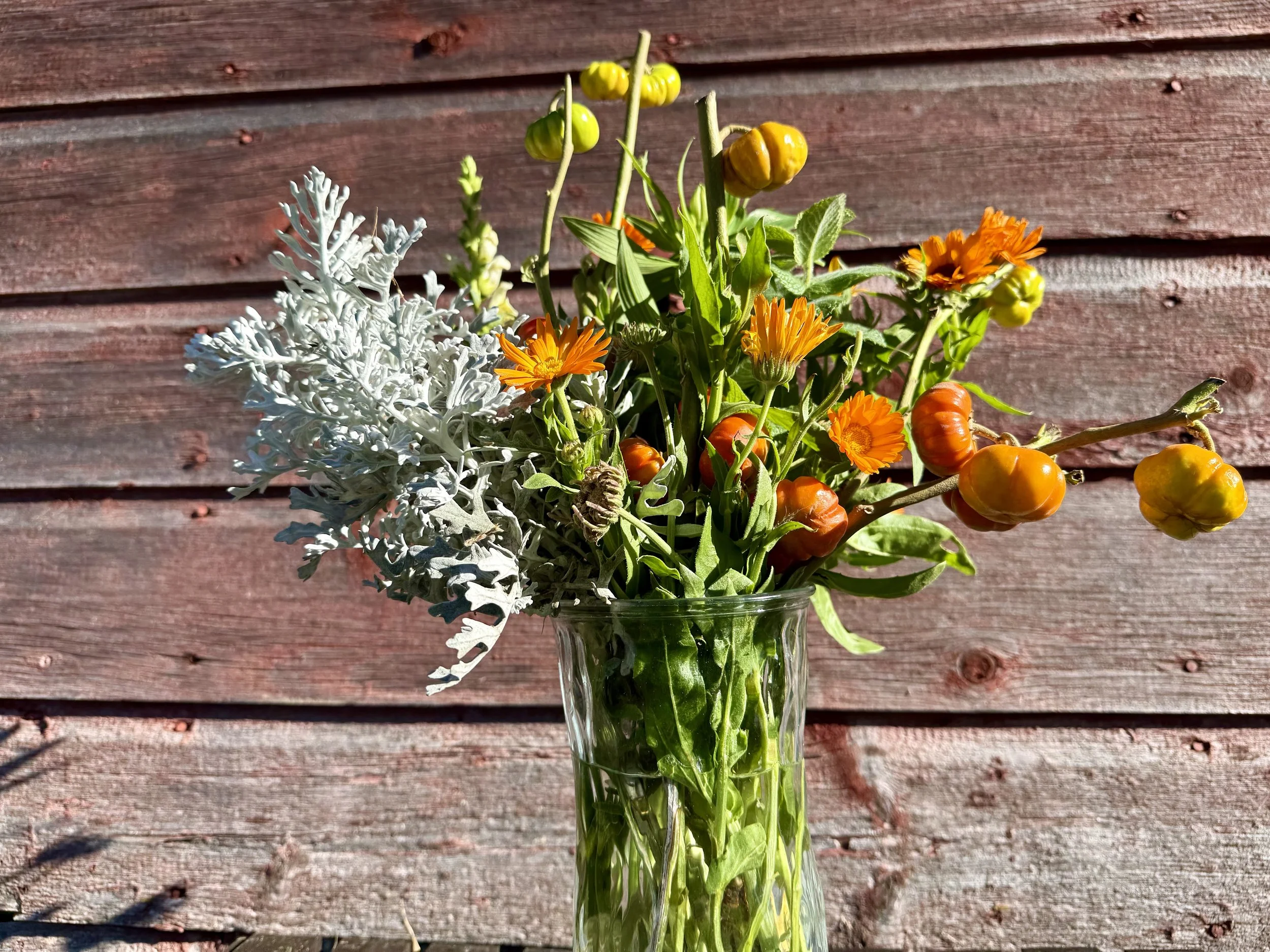
Calendula — My MVP
Calendula has been my MVP this year. I was looking for a flower to help extend the season — and calendula has done exactly that. It’s one of the first blooms to show up in spring with those cheerful yellow petals, and if you keep the plants trimmed and healthy, they’ll keep producing right up to a deep freeze. I succession plant them so I always have fresh stems.
If you harvest when there’s a mix of buds just opening and others still closed but mature, the flowers can last up to two weeks in a well-maintained vase. Calendula is also a medicinal plant, often used in teas and salves. Those same healing properties can cloud the water in a vase, so it’s important to change the water often.
If you’d like to use them for tea, pick the flowers in the morning just as the dew dries. They can be used fresh or dried.
Herbs and Greens in the Fall Mix
Calendula isn’t the only herb I use in fall bouquets. Lemongrass towers over the arrangements with its fresh-scented spears that add height, movement, and fragrance. Many mint varieties are still in good enough shape to include this time of year, and their subtle aroma makes a bouquet feel alive. Bouquet dill has become one of my favorite umbels to add — it brings a natural, lacy texture that feels right at home with fall colors.
And one of the biggest secrets? Cilantro. When picked at the right stage, it can be a phenomenal filler — arguably even better than baby’s breath.
At the base of many bouquets, I love to tuck in Russian kale. It has a surprisingly long vase life and gives a distinctive texture that grounds the arrangement beautifully.
Peruvian Lilies — Long, Elegant, and Resilient
I’ve been experimenting with Alstroemeria (Peruvian lilies) for the last few years, and I finally found a variety that produces long, beautiful stems. This is another unique offering you won’t likely find from other local growers. With the right care, they can be the showstopper in special bouquets well into October, even after the dahlias have frozen. Florists love them for their vase life — they hold their blooms until the last trace of green fades from the stem. I haven’t scaled them for wholesale yet, but they make their way into my Grower’s Choice bouquets.
Dogfennel — The Whimsical Filler
One of my secret fillers this time of year has been dogfennel (Eupatorium capillifolium). It perfectly fits our whimsical style — the plants grow over eight feet tall, can be cut as needed, and have excellent vase life. When picked in the bud stage, they have a wheat-like texture, and after about a week in the vase, the buds open into soft, silky flowers. The stems add beautiful vertical or airy horizontal movement to a bouquet.
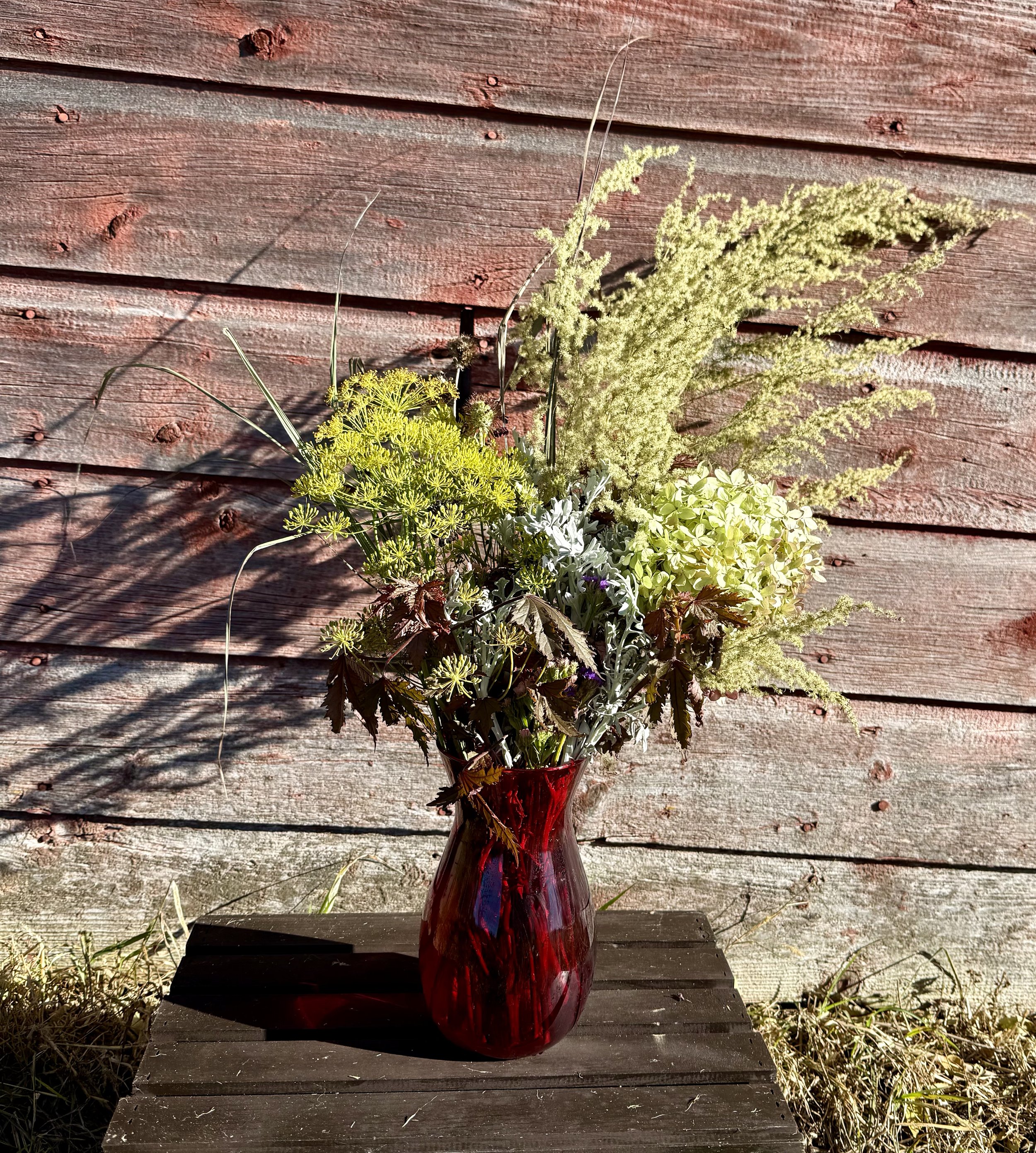
Houseplants in Bouquets
Another secret for late-season arrangements? Houseplants! They’re not scalable, but in a pinch they can add incredible texture and interest. I overwinter plants that are often treated as annuals — like angel wing begonias and scented geraniums. It’s nice to cut them back before tucking them into a sunny window for winter, so why not use those stems in bouquets? In late winter, I take more cuttings to propagate for my annual pots. I also love using greens from a few of my legacy plants that come inside each fall, like bay and variegated ginger.
Milkweed Pods — Sculptural and Surprising
It’s not truly a Firefly Hill bouquet without a touch of our land. We often use native grasses, but we also love to feature seed pods — the overlooked details that tell the story of the season.
My newest favorite accent stem is milkweed pods. After they release their silky seeds and dry out, they make fascinating additions to mixed or dried bouquets. Each one has its own sculptural shape and soft, natural color that fits perfectly into the late-fall palette. They’re a bridge between fresh and dried design — and the perfect way to close the season on a creative note.
I’ll go over some of these extra additions — the accents and wild materials we use to spice up bouquets or highlight in dried arrangements — in a later post.
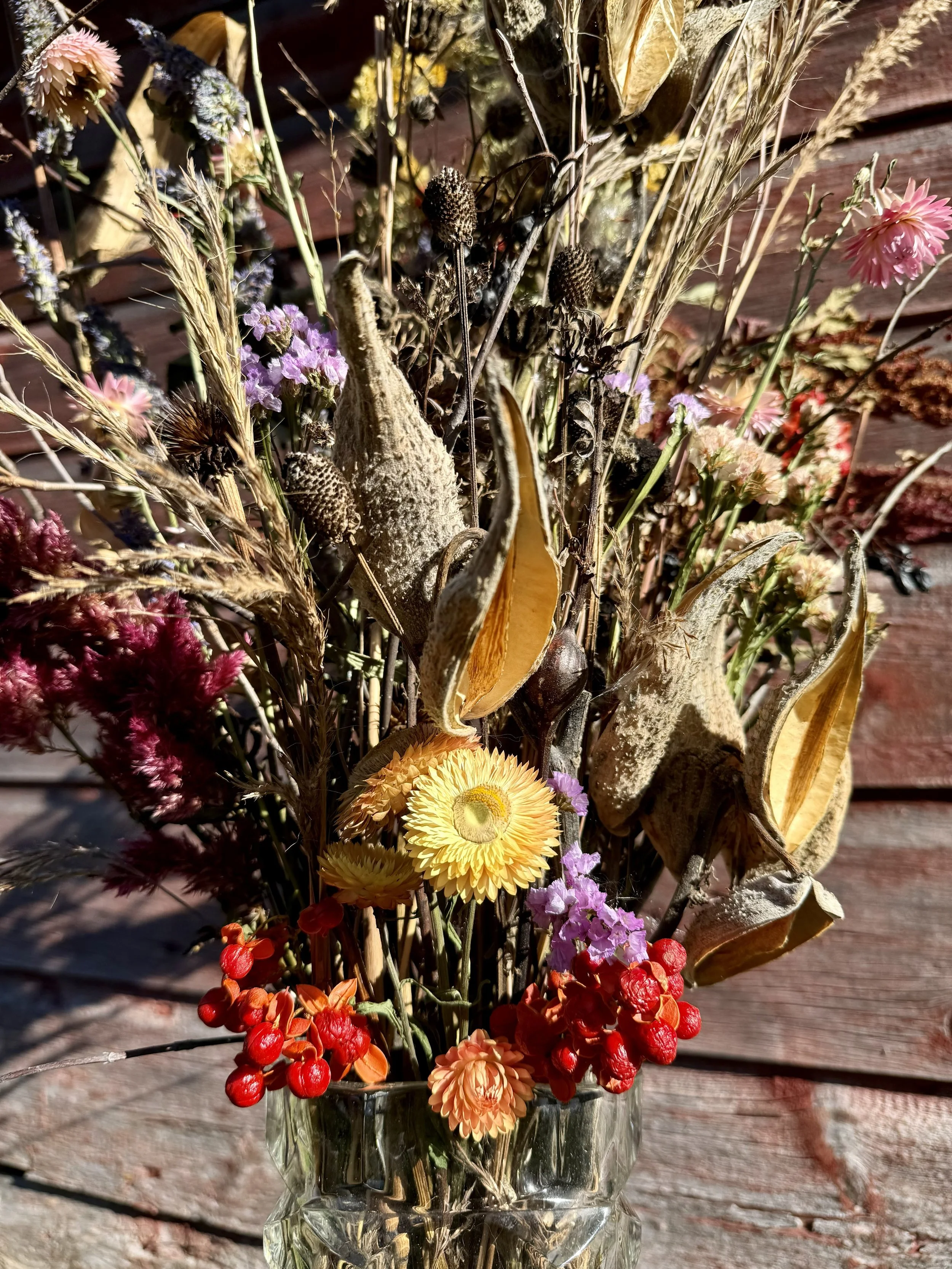
Bringing It All Together
By October, when other growers start to till in their beds, I’m still having a blast creating unique bouquets you won’t find anywhere else. These late-season arrangements often look more like something you’d find at a seasoned floral shop than a market bouquet. That’s what Firefly Hill Farm brings to its customers — unique flowers that are cut with care, cured properly, and designed to last.
These bouquets are meant to be loved, even at home, and with the right care they can last for weeks. Firefly Hill Farm’s mission is not only to provide florists and designers with beautiful, fresh, seasonal flowers, but also to give customers another way to buy artfully designed bouquets that reflect our season, our region, and the enduring beauty of locally grown blooms.
And for those of you growing flowers at home — I hope these little secrets inspire you to try new combinations, gather what’s around you, and make your own whimsical arrangements. There’s real joy in noticing what’s still alive in the garden after the frost and turning it into something beautiful.
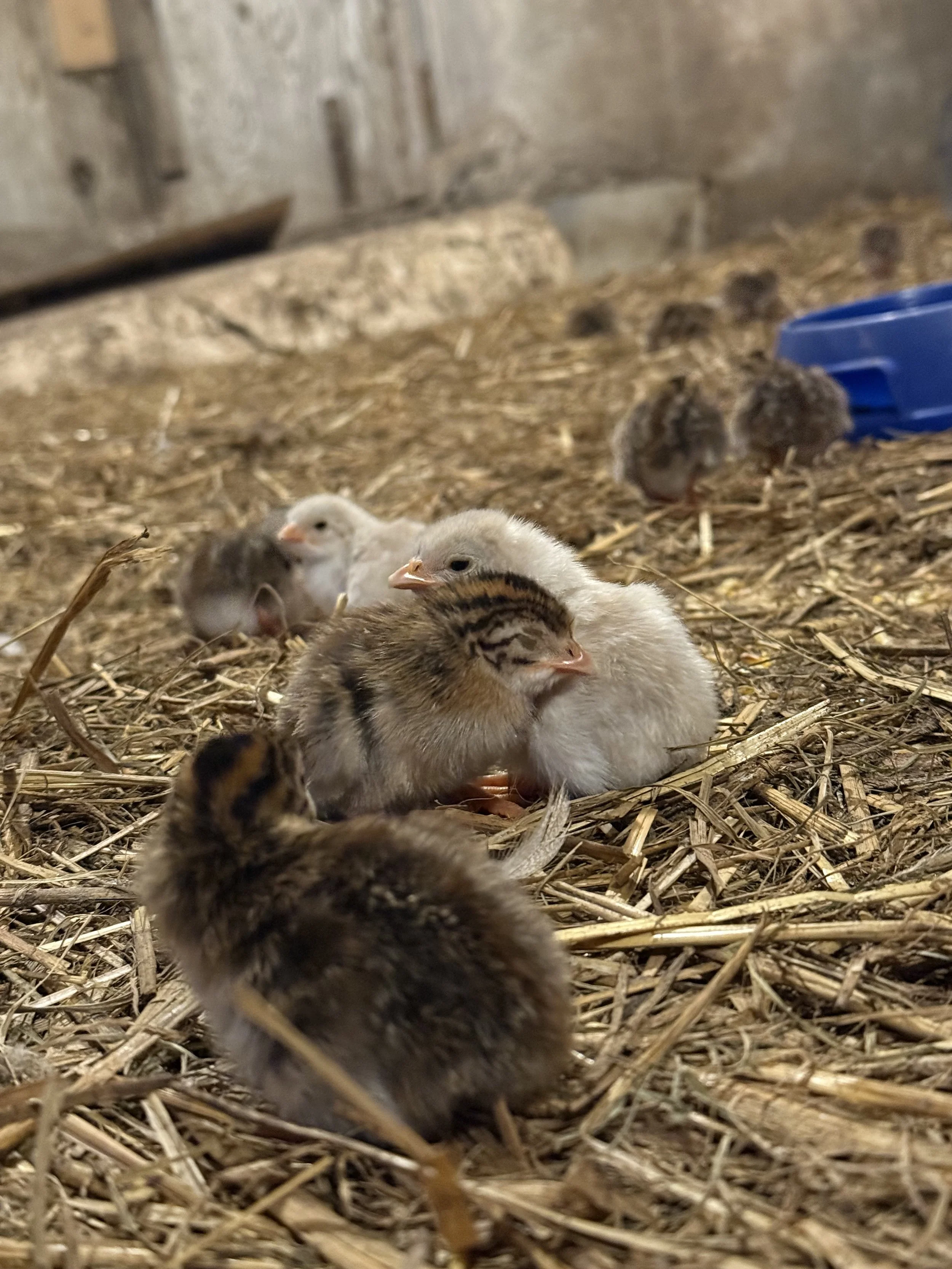
A Confusion of Guineas: The Beauty and Chaos They Bring
There are many critters on our farm, but the guinea fowl are no doubt among the most unique. We love having these beautiful, polka-dotted clowns for many reasons. First and foremost, like any animal here, they’re part of the farm simply because we enjoy hosting them.
That said, they bring plenty of practical benefits too. Between our geese, guineas, and Border Collies, the chance of an unwanted visitor sneaking by is slim. Guinea fowl act as natural guard birds—when a predator like a fox has tried to nab a duck or chicken, the guineas sound the alarm and sometimes even chase the intruder off.
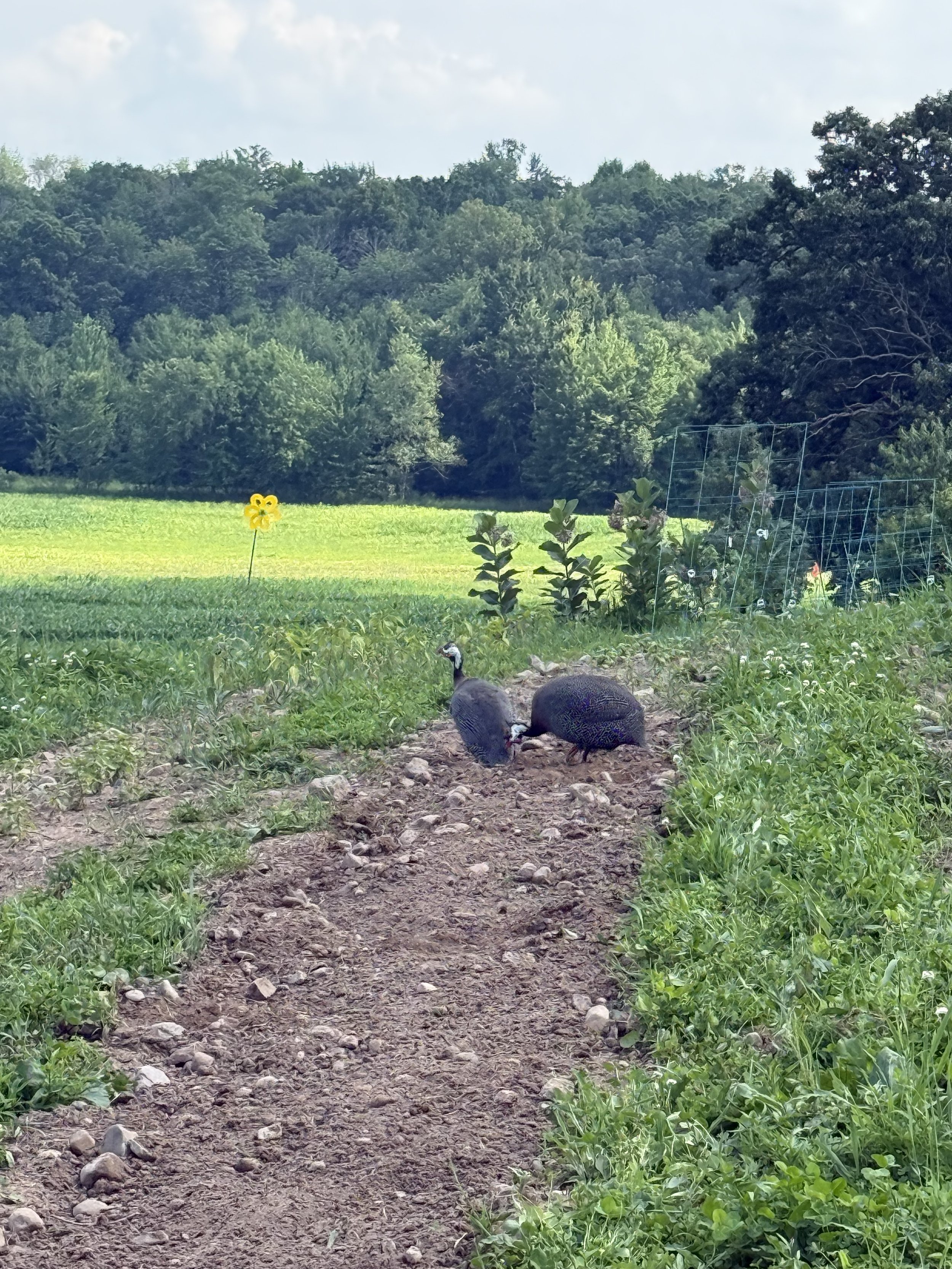
Guinea fowl inspectors — checking out a fresh row I’m prepping to plant.
The Sound of Guineas
If you’ve never heard guinea fowl, imagine a barnyard turned into an orchestra of squeaky hinges, car alarms, and cartoon characters. Their most famous call is the sharp “buck-wheat, buck-wheat!”—a two-note cry the females belt out so loudly it cuts through the entire farmyard. It’s their way of checking in with friends, and the sound can be piercing when repeated over and over.
But they also have gentler voices. When they’re calm, you might hear a softer rhythm: “yip-yip, ahaw-ahaw”—a chatter that sounds uncannily like the “Yip-Yip” Martians from Sesame Street. And when danger approaches, all bets are off. The flock erupts in a rapid-fire chorus of metallic “kek-kek-kek-kek!”, a shrill alarm that no fox, hawk, or unfamiliar visitor can ignore. It’s noisy, yes, but also one of the best security systems a farm could ask for.
Hidden Nests and Surprises
We’ve learned guinea hens like to keep their nesting habits a little mysterious. Instead of laying in the barn like the hens, they sneak off to hidden spots out in the fields or fencerows. They’ll quietly collect egg after egg until a nest holds thirty, sometimes even over forty.
Once a hen decides her clutch is ready, she settles in for the long haul. While the rest of the flock roams together, she stays behind, determined to hatch her brood. Some mornings, she’ll come to the barn door and call inside, as if checking in to let her friends know she’s still all right.
Most of the time, these nests don’t succeed—predators, weather, or just bad luck get in the way. When that happens, the hen slips back into the flock as if nothing happened. But every so often, against the odds, she returns not alone but leading a tiny troop of keets behind her. Those surprise mornings are some of the most magical on the farm.
Keets: The Next Generation
Nothing on the farm is quite as charming as the keets. Fresh out of the shell, they look like a cross between a chick and a chipmunk, with soft stripes down their backs and tiny legs that wobble as they find their balance. They huddle together for warmth, cheeping in little voices, and then dash off in bursts of energy that make them look like miniature wind-up toys.
Keets grow fast, and before long they’re chasing bugs in the grass and learning to keep up with the flock. It’s a wonder watching them transform from these fragile, fluffy bundles into the loud, speckled sentinels that race around the yard. Every time a hen manages to bring back a troop of them from a hidden nest, it feels like a small miracle—a reminder that even in all the chaos, life on the farm keeps finding its way forward.
Love and Loyalty
Guineas aren’t just spotted feathers and noise—they live with strong bonds that are every bit as memorable as their voices. Around the yard, the young sometimes play and barrel past like feathered bowling balls, running full-tilt with no thought of slowing down. These birds are deeply social; you’ll hardly ever see one alone. And when you do, it’s usually perched on the highest roof or post it can find, calling again and again until the missing buddy answers back.
Last year, we had a hen who was an especially devoted mother. She proudly paraded her keets through the yard, across the flower field, and into the hay field, showing them the world step by step. One day, a fisher—rarely seen this far from the woods—struck in the hay field and took her. Miraculously, every single keet made it back to the barn on their own. And then something remarkable happened: her mate, Pops, stepped up.
He didn’t have the same instincts—at first he looked a little awkward, unsure of what to do—but over time he became the best dad on the farm. Pops guarded, guided, and cared for those keets until they were old enough to fend for themselves. It was clumsy and touching all at once, and it showed just how much heart these funny birds can have.
Just this past Saturday, we were blessed again—a handful of new keets appeared at the barn door. I scooped them up one by one into a tub and moved them closer to a section of the barn we had set aside as a safe home for the new family. Now we’re excited to watch them grow, and we’ll be here to give the parents whatever support they need to raise their young.
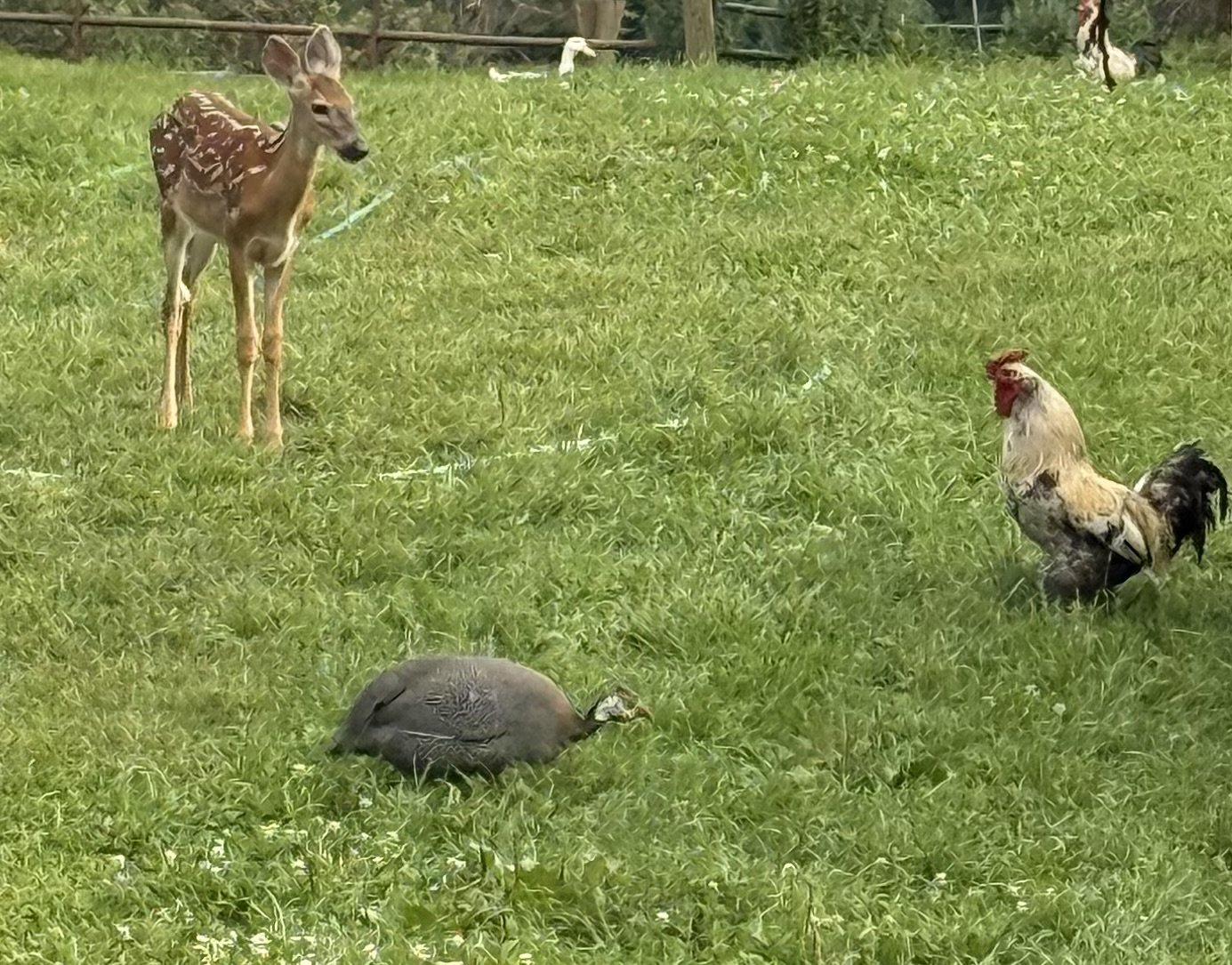
Farm pals: a curious fawn, our roosters, a duck, and a guinea hanging out like they own the place.
Chaos and Color
Guineas definitely bring their share of chaos and color to the farm. Fittingly, their collective noun is a confusion of guineas. And that’s nature—exactly what we embrace here. Every sound, every dash through the yard, every quirky habit is a reminder that farming isn’t about controlling everything—it’s about living alongside the wild rhythms of the land.

The Meaning Behind Firefly Hill Farm
On June nights, fireflies spill from the fields into our flower beds, reminding us that healthy habitat makes the land glow. At Firefly Hill Farm, we give space for wildlife and pollinators, and in return they help our flowers thrive. The same balance that lights up summer nights is what makes our blooms so special.
On June nights, our farm glows. Fireflies rise from the fields below the hill, where dew gathers on grasses and webs, then spill into the yard and flower beds. That moment — standing among blooms while thousands of fireflies blink around us — is the reason we named our farm Firefly Hill Farm.
Fireflies aren’t just beautiful; they signal a healthy landscape. Their presence tells us the soil, water, and habitat here are thriving, and that shapes how we farm.
We keep grass tall and let clover bloom across both yard and fields, feeding pollinators, deer, and rabbits. That abundance keeps browsing pressure down on the flowers. We leave stems standing through winter so insects can overwinter, and we let prairie plants like asters and Joe-Pye weed reclaim parts of the hill rather than mowing them back.
Wildlife has answered. Sandhill cranes raise colts here, geese rest during migration, and families of deer wander through the garden. Sometimes they nibble, but more often they’re simply part of the daily rhythm of the farm. Even the insects tell a story — on summer evenings, soldier beetles cover the rudbeckia, a reminder that not every swarm is a problem, and that many insects are part of the balance that keeps our fields thriving.
That balance shows in the flowers. Chickens and guineas turn waste into compost and manure that feed the beds, while beneficial insects protect the plants. The result is flowers that are not only beautiful in a vase, but also reflect the health of the land they grew from.
The same habitat that creates a June night filled with fireflies is what makes our flowers so special. Both are born from the same living landscape, and both remind us that when we give nature space, it answers with beauty.