

The Wild and Wonderful Birds of Firefly Hill Farm (By Season)
If you spend any time at Firefly Hill Farm, you’ll notice something pretty quickly: it’s rarely quiet. Yes, our domestic birds have opinions, but the wild birds are just as audible. House sparrows chatter as they bounce from crab apple to crab apple. Blue jays have an array of calls—from metallic “donks” to perfect impressions that can sound like a hawk. Woodpeckers drill into trees for a snack. Ravens clonk as they do acrobatics in the sky. In spring, cranes call across the marsh and the sound carries into the distance. Even the wings overhead have their own sound—pigeons (our little “Firefly Air Force”) circling the farm and patrolling the sky. There are a lot of birds here, so this is a long post. If you don’t want to take it all in right now, feel free to skim—winter is where we’ll start, because winter is where people assume everything goes quiet, and that couldn’t be further from the truth.
Winter: Feeders, finches, and surprise visitors
Most days in winter the homestead feels surrounded by life. We’ll often have three to five pairs of cardinals, a steady bounce of blue jays moving between treetops and feeders, and juncos and house sparrows hopping under the feeder line and slipping back into the hedges. Pine siskins, white-breasted nuthatches, and tufted titmice work the trees like they’re built for it—up, down, sideways, sometimes upside down. Woodpeckers move between suet and the standing dead trees we leave on safe parts of the property. (We keep a few snags because they’re habitat—simple as that.) One of our favorite winter routines is feeding the birds. We don’t feed all season long—most of the year the farm offers plenty through berries, insects, and seeds, and we also don’t need extra reasons to draw in herbivores like deer and rabbits. But in winter, feeders turn the yard into a little viewing stand. This year we strung a clothesline across three trees and hung platform feeders for “everybody,” tube feeders for finches, and a few ground feeders for juncos. Squirrels get into it no matter what; we live with it—and they’re part of the show. Deer clean up what hits the ground, and wild turkeys come by now and then to see what everyone left behind.
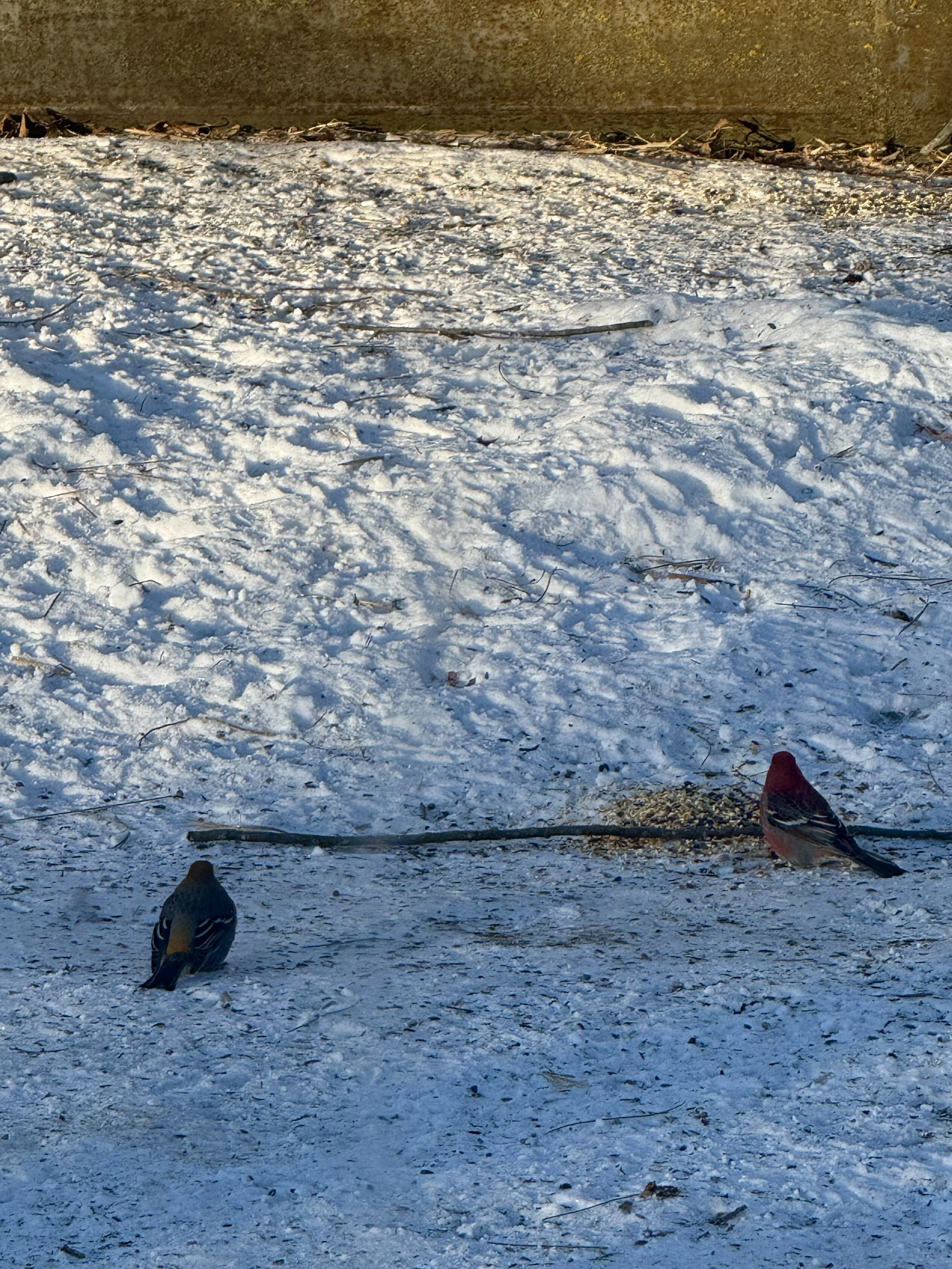
Rare sighting: Pine Grosbeaks at the feeder — male (red) and female (gray/brown).
This winter we had a rare visitor—one that’s new on our life list: pine grosbeaks. A male and a female showed up during this stretch of weather that felt like Canada, and they stuck around long enough to feel like part of the place for a while. They stood out immediately, and we watched them working the winter leftovers—likely sunflower seed scraps on the ground. Winter also makes predators more visible. We often see a red-tailed hawk posted up in a giant oak in the pasture, scanning the harvested field. We also get sharp-shinned hawks around the farmstead—smaller, bolder, and sometimes willing to stalk the feeders. We’re careful with our livestock, especially the babies, but we also respect the role these birds play in keeping rodents in check. We get flybys of bald eagles traveling to and from the Chippewa River too. And at night, owls are part of the soundtrack as well—barred owls and great horned owls—the kind of presence you often hear before you ever see.
One quiet reason winter stays busy here is that we try not to strip everything down in fall. People clean up their gardens and plots for good reasons—time management, disease control, aesthetics—but we keep as much standing as possible through winter on purpose. We aren’t “never-cleanup” people; we just clean up differently and later. The main perennial we cut back in fall is iris, to reduce the possibility of overwintering iris borer. Most other perennials stay standing until spring when beneficial insects begin waking up, and our cut fields are left standing until the ground thaws. Leaving stems and seed heads matters because it keeps food in the landscape. Even in deep winter we’ll watch finches and sparrows pick seed from plants many people would have cut down: bee balm, rudbeckia, scabiosa, and more. Ageratum and amaranth can drop thousands of seeds too, and that food adds up when every calorie counts. We also cycle nutrients back onto the fields in winter by spreading barn waste from our bird bedding onto the cut fields—nothing glamorous, just real farm cycling that adds organic matter and keeps the ground protected through the hardest stretch of the year.
Spring: Scouts, marsh music, and the first big return
We like to think spring starts in late February. Some years we’ll get robin “scouts” first—stopping by the farm and then lingering near an elm out in one of the fields for a few weeks. Last year we saw our first robins and red-winged blackbirds on the same day: March 12. The fields pull in killdeer too. If you’ve ever walked near a killdeer nest, you know the performance—acting injured to lure you away. It’s dramatic and it works. Canada geese move in, and sometimes we’re lucky enough to see tundra or trumpeter swans and blue-winged teal moving through. Spring migration brings visitors too—fox sparrows, white-throated sparrows, black-and-white warblers, and lesser and greater yellowlegs.
And then comes the farm favorite: sandhill cranes. We have a plaque in one of our grow rooms from 1981 that says this farm is an owner of a crane marsh. Today cranes are more common than they used to be, but they still don’t feel ordinary. They come early and check what changed over winter. They do a beautiful courting dance. And there is nothing like their trumpeting call—every time we hear it our hearts fill up. One of our favorite days of the year is the annual crane count. We pack coffee and Dunkin donut holes (munchkins), leave the house around 5:30, and head to the far end of the property. We sit by an old deadfall and listen to cranes coming in. We usually count 20 to 30. One year we even heard a bobcat mating call while we sat there—if you’ve never heard it, it’s worth looking up, and it might be one of the most dreadful cries you’ll ever hear. This year we even had a woodcock try to nest between our prairie and driveway. We didn’t get to see baby woodcock, but we took the attempt as a compliment. After reading Doug Tallamy’s Bringing Nature Home, we stopped mowing under our oak trees to leave more habitat for the insects that feed birds. Now it’s a patchwork of asters, grasses, Joe-Pye weed, raspberries, and whatever else wants to join—and spring feels louder because of it.
Summer: Sunflowers, swallows, and hummingbirds
By June, it might as well be summer here. Plants are racing, and the bird calendar shifts again. Bluebirds are established, preceded by orioles, and then the ultimate summer bird arrives: the ruby-throated hummingbird. This year we had a beautiful pair of red-headed woodpeckers nesting in the yard—the kind of bird that makes you stop what you’re doing just to get a better look or listen. We also love the swallows—barn swallows and tree swallows—along with bobolinks, brown thrashers, and the tiny little chipping sparrow. We leave a lot of sunflowers standing and we also grow varieties that are better for birds in addition to varieties we grow for cut production. It’s always a blessing to sit up by the flower field and watch American goldfinches fly from sunflower to sunflower and gorge themselves like they found the best buffet in the county. And in the background of all of it, cranes walk the hay and cornfields—and if we’re lucky, we’ll see colts moving with their parents like tiny dinosaurs.
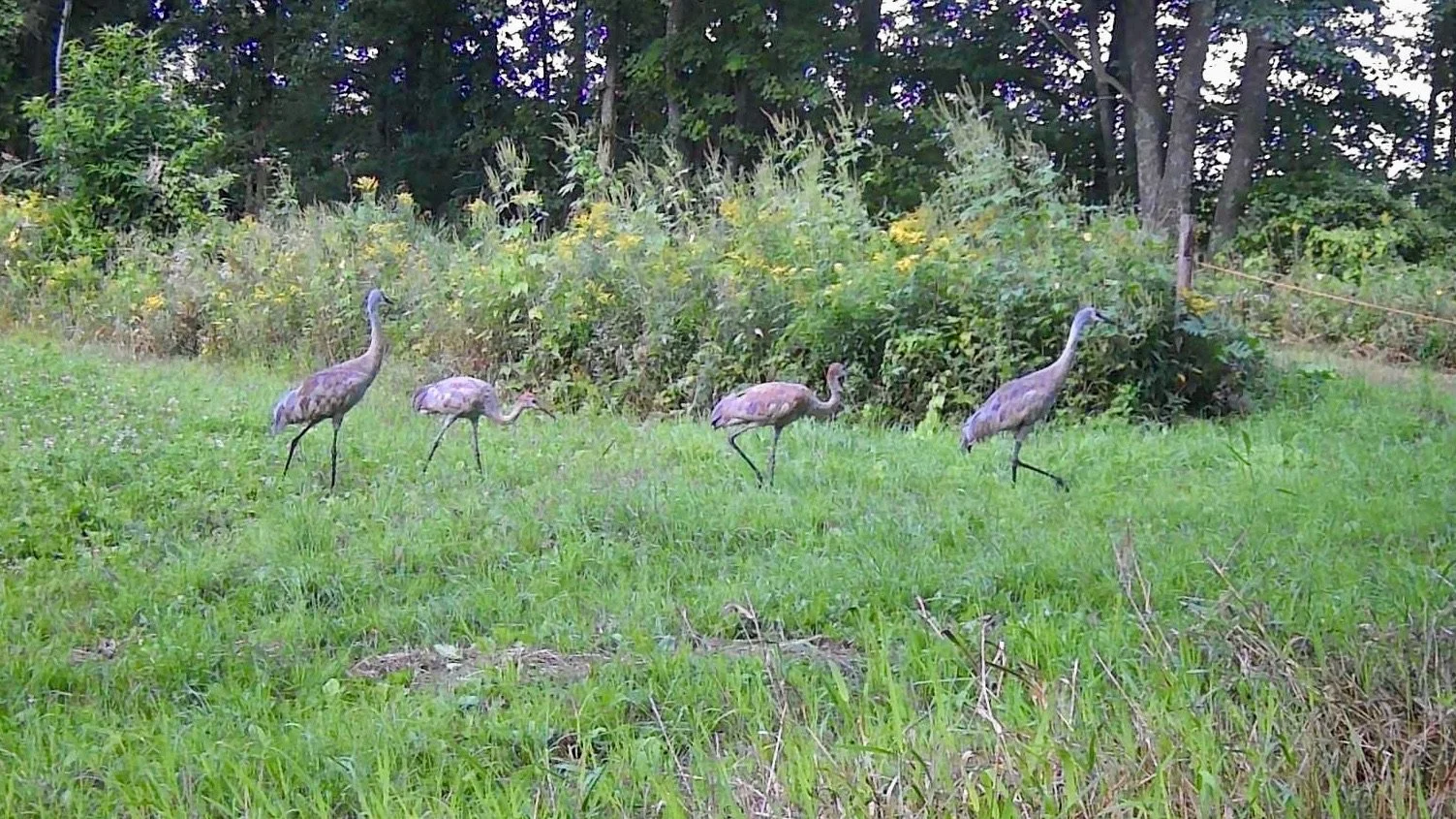
Sandhill crane family in the hayfield — two adults with their colts.
Fall: Swarms, waxwings, and goodbyes
One of the first signs the season is turning is the swarming of nighthawks. We’d never seen anything like it until we came to the farm. They look like a cross between a seabird and a hawk. As evening approaches, they soar through—sometimes hundreds of them—eating insects when insects are at their peak. Another fall favorite is the cedar waxwing. When honeysuckle berries ripen and ferment, those birds seem like they’re having a party. Last season we found a fledgling and it was one of the cutest little angry muppet-things we’ve ever seen.
Fall is also when the crane story turns bittersweet. You can watch the parents take the young ones up and practice flying for weeks. Then one day they lift off, circle higher and higher until they’re just a dot in the sky, and you know they’re on their way out for the season.
Winter again: the familiar birds return
As some birds move on, others return. The arrival of the dark-eyed junco is genuinely one of the best parts of winter. The feeder rhythm starts up again. The yard gets loud again. And the “quiet season” proves—again—that it isn’t really quiet. And maybe, if we keep taking care of the land—leaving cover, leaving food, leaving the edges wild enough to function—we’ll get lucky and see those pine grosbeaks again. That’s the hope. Because at Firefly Hill Farm, the birds aren’t an extra. They’re a sign that the place is alive.
Favorite Birds of Firefly Hill Farm (common name — scientific name)
House Sparrow — Passer domesticus
Dark-eyed Junco — Junco hyemalis
Northern Cardinal — Cardinalis cardinalis
Blue Jay — Cyanocitta cristata
Pine Siskin — Spinus pinus
White-breasted Nuthatch — Sitta carolinensis
Tufted Titmouse — Baeolophus bicolor
American Goldfinch — Spinus tristis
Red-headed Woodpecker — Melanerpes erythrocephalus
Ravens (Common Raven) — Corvus corax
Rock Pigeon — Columba livia
Barn Swallow — Hirundo rustica
Tree Swallow — Tachycineta bicolor
Bobolink — Dolichonyx oryzivorus
Brown Thrasher — Toxostoma rufum
Chipping Sparrow — Spizella passerina
Ruby-throated Hummingbird — Archilochus colubris
Red-tailed Hawk — Buteo jamaicensis
Sharp-shinned Hawk — Accipiter striatus
Bald Eagle — Haliaeetus leucocephalus
Turkey Vulture — Cathartes aura
Barred Owl — Strix varia
Great Horned Owl — Bubo virginianus
Canada Goose — Branta canadensis
Blue-winged Teal — Spatula discors
Tundra Swan — Cygnus columbianus
Trumpeter Swan — Cygnus buccinator
Killdeer — Charadrius vociferus
Lesser Yellowlegs — Tringa flavipes
Greater Yellowlegs — Tringa melanoleuca
Black-and-white Warbler — Mniotilta varia
Fox Sparrow — Passerella iliaca
White-throated Sparrow — Zonotrichia albicollis
American Robin — Turdus migratorius
Red-winged Blackbird — Agelaius phoeniceus
Sandhill Crane — Antigone canadensis
American Woodcock — Scolopax minor
Common Nighthawk — Chordeiles minor
Cedar Waxwing — Bombycilla cedrorum
Pine Grosbeak — Pinicola enucleator
Baltimore Oriole — Icterus galbula